

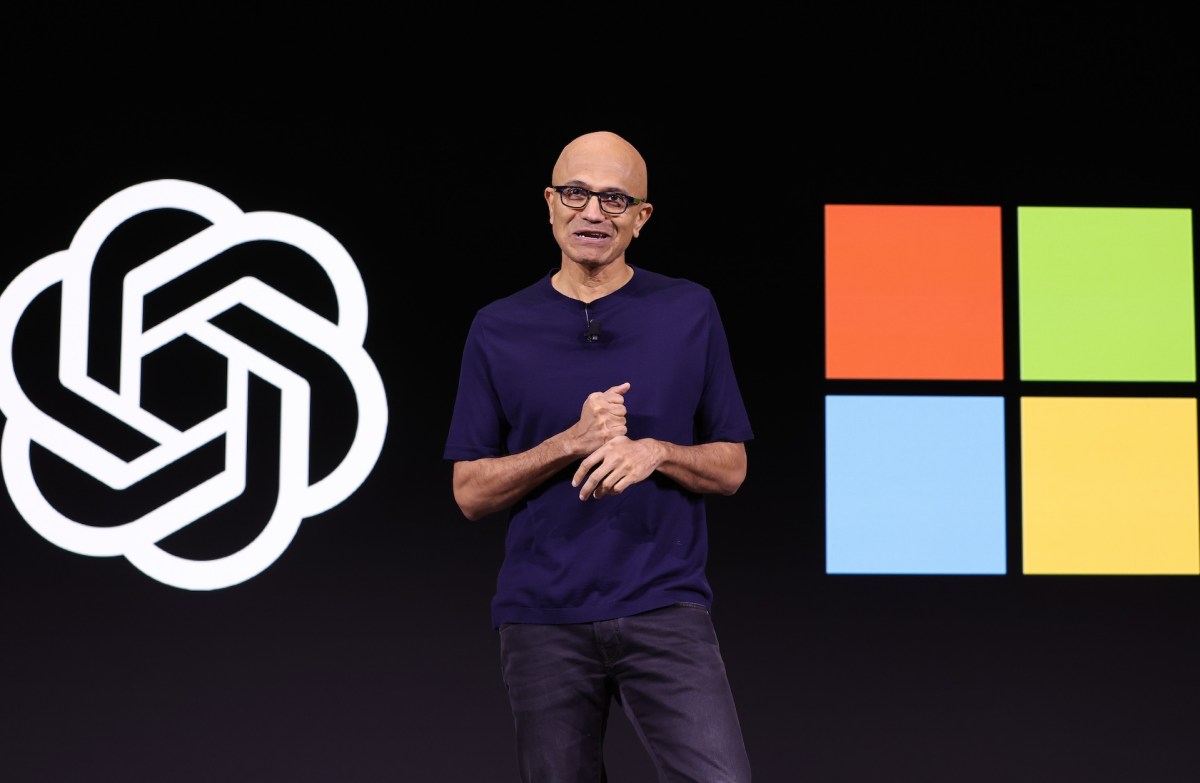
Of all the debates raging about the potential downsides of artificial intelligence, one concern has been causing the most hand-wringing among AI enthusiasts in Silicon Valley. The fear is that the giant AI labs selling proprietary models are acting like Trojan horses. As startups and enterprises integrate models from companies like OpenAI and Anthropic, these labs gain increasing access to their customers' most sensitive business information. The model makers could then use that knowledge for themselves, potentially becoming competitors to their own customers. This warning has been issued by a range of voices, from venture capitalists like Jason Calacanis to Palantir CEO Alex Karp.
Now, in a surprising blog post published recently, Microsoft CEO Satya Nadella has joined this crowd. Nadella warns that AI users—whom he calls the "buyers"—are paying twice. They knowingly spend money for AI token usage, but they also, obliviously, hand over valuable data in the process. "You essentially pay for intelligence twice, once with money, and again with something even more valuable: the proprietary knowledge you must reveal to make that intelligence useful. The better you want the model to perform, the more of that knowledge you have to feed it!" he writes.
Most dangerously, enterprises are literally teaching the models about the nuances of their businesses. "Models learn from 'exhaust,' the prompts people write, the tools agents use, and especially the corrections people make when the model is wrong. Every correction is distilled into institutional know-how," Nadella writes. He describes this as "the kind of knowledge a competitor could never buy," yet enterprises are handing it over freely.
Nadella's Argument for Fairness
Nadella argues that if AI companies have the right to freely scrape the internet to train their models, it is only fair that enterprises get to study—or "distill"—those models in return. Distillation is the practice of using a model's own outputs to learn how it works and to train a new, often cheaper, model based on those insights. This practice has become controversial. In February, Anthropic accused Chinese open-source models of sending millions of prompts to Claude as a way to improve their own models and urged the U.S. government to crack down on export controls.
Nadella's point is that model makers cannot have it both ways. It is hypocritical for them to freely train on the world's data while restricting others from doing the same to their models. "While the great innovation that comes from model providers having fair use rights to train models on public data is needed, I find it ironic that the status quo is to then turn around and impose restrictive terms on distillation," he writes.
Nadella is particularly concerned when model makers "reserve the right to learn from customer usage and interaction data." This kind of data can include proprietary algorithms, customer lists, financial projections, and strategic plans that companies input into AI tools. Over time, the AI provider could infer a company's competitive advantages and potentially use that information to benefit itself or its other customers.
The Proposed Solution: Retain Ownership and Build Orchestration Layers
Nadella's solution is the kind of thing the CEO of a giant cloud provider would suggest. He wants companies to "retain ownership" of their data, including prompts, feedback, and corrections. He urges them to build their own "proprietary learning environments" on the cloud—where their data is likely already stored anyway and, conveniently, could mean Microsoft's Azure. He also recommends building in what he calls "orchestration layers"—essentially, a way to easily switch between AI models from different providers rather than being locked into one. Tools like AI gateways that let companies do exactly this have become increasingly popular.
While Nadella never uses the words "open source" as the method for retaining ownership, this is an obvious subtext. Large companies, many of which still operate some of their own data centers in addition to using the cloud, are already moving to open-source models installed on their own premises ("on-prem" in industry jargon). Idit Levine, founder and CEO of Solo.io, a company that makes networking and security software for managing AI systems, says she is seeing this shift play out with her own customers. After experimenting with proprietary model makers, they start asking themselves: "Can I take an open-source model and run it on-prem? It will do almost 90% of what the big one's doing. It will cost way less," she reports. "They understand that, and they can control it."
Solo.io's technology was selected to power the Linux Foundation's Agentgateway project. Its customers include large enterprises like T-Mobile, ADP, and SAP. Levine sees companies increasingly installing on-premise open-source models and believes this is the next big wave in enterprise AI use. She is not alone. Vercel, best known as a platform for building and hosting websites, has recently added AI model-switching tools. OpenRouter, a company that helps developers route requests across different AI models, is also seeing a surge in traffic to open-source models. In fact, open models accounted for 29% of all traffic routed through Vercel's gateway last month.
Background: Microsoft's Dual Role in AI
Nadella's warning carries extra weight because Microsoft has invested heavily in both OpenAI and Anthropic, two of the leading proprietary model makers. Microsoft has integrated OpenAI's models into its Azure cloud platform, its Office suite, and its search engine Bing. At the same time, Microsoft also offers its own AI models, such as the Phi series, which are smaller and more specialized. This dual role—as both an investor in proprietary AI and a provider of cloud infrastructure that could support open-source alternatives—puts Microsoft in a unique position.
Nadella's blog post appears to be a strategic move to position Microsoft as a neutral platform that supports both proprietary and open-source AI. By warning enterprises about the risks of proprietary models, he may be encouraging them to use Azure for their data and then choose whichever model they prefer through an orchestration layer. This would increase Azure's stickiness while reducing dependency on OpenAI and Anthropic. It also aligns with a broader industry trend where enterprises are becoming more cautious about vendor lock-in and data sovereignty.
The history of enterprise software is filled with examples of companies that ended up dependent on a single vendor's platform, only to face rising costs and limited flexibility. In the AI era, the stakes are even higher because the data that feeds these models can be the company's most valuable asset—its intellectual property, customer relationships, and process efficiencies. Nadella's warning taps into this anxiety and offers a path forward that gives enterprises more control.
Real-World Implications and the Rise of Open Source
The shift toward open-source models on-premises is already underway. Many enterprises find that open-source models, such as those from Meta (Llama), Mistral, or the Alibaba-backed Qwen, can perform the majority of tasks required for internal use cases—like summarizing documents, generating code, or analyzing customer support tickets—at a fraction of the cost of proprietary models. Because these models can be run on their own hardware, the data never leaves the company's network, eliminating the risk that a model maker could learn from it.
However, running open-source models is not without challenges. It requires technical expertise, infrastructure investment, and ongoing maintenance. Companies need to fine-tune models on their own data, manage version updates, and ensure security compliance. This is where cloud providers like Microsoft Azure come in, offering managed services that make it easier to run open-source models securely. Nadella's proposal of building "proprietary learning environments" on the cloud essentially combines the control of on-premises deployment with the scalability and convenience of cloud computing.
Another key aspect is the concept of distillation neutrality. If enterprises can distill knowledge from proprietary models without restrictive terms, they can create smaller, cheaper models that are tailored to their business. This could democratize access to advanced AI capabilities, allowing even small and medium-sized businesses to benefit from AI without exposing their secrets to large labs. But model makers like OpenAI and Anthropic are unlikely to give up this advantage easily. They argue that distillation can infringe on their intellectual property and lead to models that imitate their performance without proper compensation.
The debate over data ownership and model distillation is likely to intensify as AI becomes more embedded in business operations. Regulators may step in to define the boundaries of fair use. The European Union's AI Act, for example, includes provisions about transparency and data governance that could affect how model makers train their systems. In the United States, discussions about AI regulation are ongoing, with some lawmakers calling for rules that protect customer data from being used to train models without explicit consent.
With the CEO of Microsoft—a company with the deepest pockets and broadest reach in enterprise AI—openly urging caution, the trend toward open-source and on-premises AI is set to accelerate. As Nadella writes, "In consuming intelligence, you are creating intelligence. And what you create should belong to you." This message resonates with companies that have long struggled with data ownership in the cloud era. For them, the promise of AI is immense, but the risk of losing their competitive edge is even greater. The solution they choose will shape the future of enterprise technology for years to come.
Source:TechCrunch News