

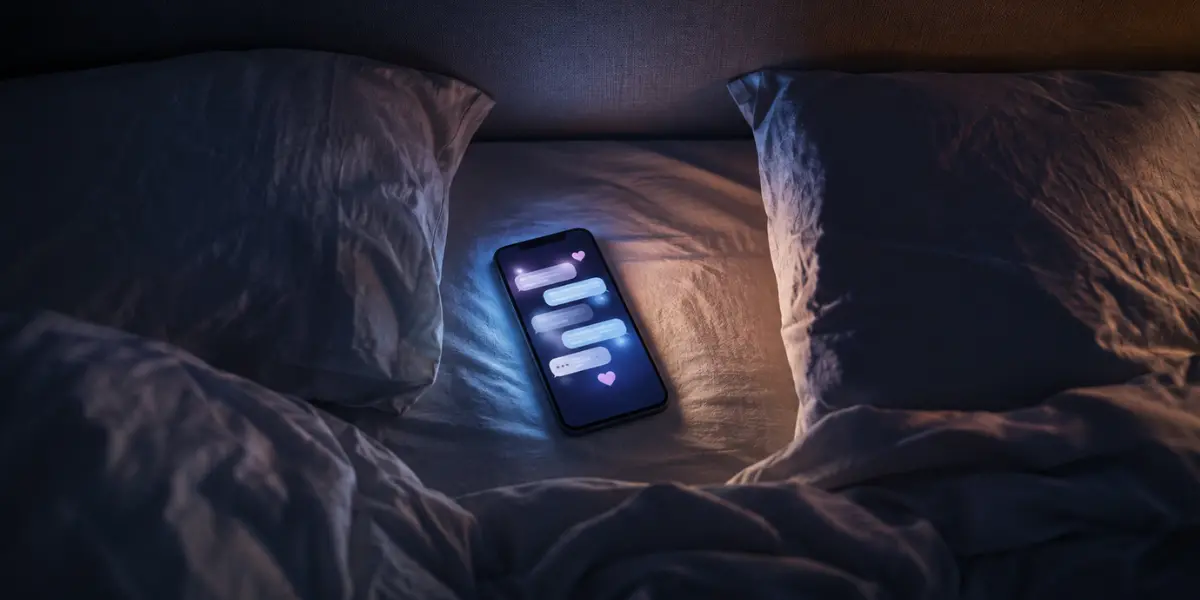
A recent survey has found that 50.5% of Americans believe a romantic relationship with an artificial intelligence tool should be considered cheating. The number is striking not because it represents a supermajority, but because it is the first sign that digital companionship has officially crossed the boundary between simple entertainment and partnership territory. With AI chatbots becoming more personal and more emotionally responsive, the line between harmless role-play and real relationship betrayal is dissolving. For a growing number of people, an AI romance is no longer just a curiosity; it is a threat to trust.
A Statistical Point of No Return
Surveys that measure attitudes toward digital infidelity usually produce wide gaps between generations or gender groups. This survey, however, shows the overall public is almost evenly divided. Fifty point five percent to 49.5 percent is a difference of only one percentage point. That narrow margin suggests that America is in the middle of a cultural reckoning about what defines fidelity in the age of intelligent machines. Modern relationships no longer exist only in physical spaces. They also live in text messages, social media, and now in the personalized replies of a chatbot.
The fact that just over half of adults view AI romance as cheating indicates a mainstream shift. A decade ago, any meaningful number of people would likely have dismissed the idea of caring about a machine relationship. Today, millions of adults talk to AI companions daily. Those conversations range from simple chit-chat to deeply intimate exchanges about loneliness, fears, and sexual desire. When one person in a committed relationship does that behind their partner’s back, many Americans recognize it as a form of deception.
What Counts as an AI Romance?
An AI romance can take many forms. It might involve a free chatbot designed to mimic romantic partners. It can also happen inside a video game, a virtual reality environment, or a custom-made generative AI persona. Some apps are built specifically for companionship and use carefully designed personalities that remember details of a user’s life. Users can choose the voice, appearance, and emotional temperament of their digital partner, which makes the interaction feel even more real.
These AI systems do not simply respond with generic lines. They learn from the user’s past messages and adjust their tone to match emotional needs. Someone who is having a difficult day may receive comforting words. Someone who feels unseen by their spouse may seek validation from an app that asks questions and remembers the answers. Over time, this can create a serious emotional attachment. The user may begin to prioritize these talks over conversations with their real partner. That is where the perceived betrayal begins.
Emotional Cheating Is Not a New Concept
Before the internet, emotional infidelity usually happened with someone from work, a friend, or an acquaintance. People exchanged letters, long phone calls, and lunches. They shared secrets they did not share with their spouse. The relationship may never have become physical, but the intimacy was real. Psychologists have long argued that emotional infidelity can hurt just as much as physical cheating because it reallocates attention, care, and affection.
AI romance is emotional cheating without another human on the other side. Yet from the perspective of the hurt partner, the effect is similar. A husband may not care whether the woman his wife is in love with exists in the physical world. What hurts is that his wife is telling someone else about her feelings, checking in with someone else, and looking forward to another conversation that he cannot be part of.
Why the Divide Exists: The Case for Cheating
People who call AI romance cheating tend to focus on three factors: secrecy, emotional investment, and the replacement of human intimacy. If a partner hides an AI companion behind closed doors, clears chat histories, or feels embarrassed when discovered, that behavior strongly resembles traditional infidelity. Even if there is no physical contact, the participant is choosing an artificial emotional partner instead of addressing needs with the person they love.
Additionally, many AI chatbots are designed to be flirtatious or romantic. Users can start conversations with an AI that explicitly plays the role of a lover. Those conversations can include sexual fantasies, love declarations, and daily affirmations of attraction. A partner who walks in on such a conversation is likely to feel just as betrayed as they would if they discovered real-world messages with an old flame. The degree of immersion depends on the individual, but the emotional dependency can be powerful.
Why the Other Half Disagrees
On the other side of the debate, many Americans argue that an interaction with software cannot carry the same meaning as an interaction with a person. A machine has no intentions, no consent, no social power, and no ability to take over another person’s life. It is a user-created fantasy like reading a romance novel or watching a television show. The user is not betraying a partner because there is no other human soul on the other end.
For this group, AI romance is closer to an interactive daydream. They may see it as a harmless stress release, especially when the real relationship is healthy. Some even use romantic AI prompts together with their partner to explore fantasies safely. In that context, the chatbot is not an affair; it is a toy. They also point out that many people do not consider masturbation or consuming adult fiction as cheating, even when they involve attachment to fictional characters. From this perspective, cheating specifically means betraying a human being, and a machine has no claim to that bond.
The Complexity of Intent and Secretive Use
Much of the disagreement may come down to intent. If a person uses an AI companion innocently during idle hours and tells their partner about it, few would call it an affair. If the same person hides the relationship and feels a growing dependency, it becomes more suspect. The problem is that people often do not realize how attached they have become until they have already crossed a line. Because AI companions are designed to provide unconditional support, they can become a refuge when arguing with a real partner. That refuge may prevent a couple from repairing issues because one side receives temporary comfort elsewhere.
Relationship experts often describe the warning signs of emotional infidelity. Many of these signs also apply to AI relationships. A person may become possessive of their phone. They may stay up late at night talking to their chatbot. They may mention a friendless character or joke about their AI partner, which is a way of introducing the topic without revealing how serious it really is. They may become emotionally distant and less interested in shared activities. In severe cases, they may refuse to delete the app even after their partner tells them it hurts the relationship.
What the Skeptical Majority Means for the AI Industry
The finding that just over half of Americans consider AI romance to be cheating has practical consequences. Product developers at companies that produce companion apps are watching such cultural percentages carefully. If many consumers view their products as a source of relationship damage, pressure will mount for clearer warnings, safer design, and stricter boundaries. New versions of AI tools may be programmed to decline romantic role-play when they detect that the user appears to be in a committed relationship, although such detection would be difficult to implement fairly.
At the same time, lawyers who handle divorces are beginning to look at digital companions as possible evidence in custody and property disputes. Text logs from a chatbot could be used to show a pattern of emotional detachment, though the law in most places still defines an affair in physical or legal terms. As AI becomes more sophisticated, courts may have to decide whether a close, secret emotional attachment with a software program is relevant to a marriage contract. The phrase “artificial romance” may eventually become as familiar as “online dating” in legal discussions.
How Couples Can Define Their Own Boundaries
The most direct answer to the survey may be that every couple has to create its own personal policy. Some relationships permit playful texting with AI. Others view any flirtatious exchange with a machine as a betrayal. What matters is not a national survey but the actual feelings of the two people in the relationship. If a spouse reveals that an AI conversation made their partner’s stomach drop, the healthiest response is to ask why it felt threatening and what need is not being met.
A productive conversation should include questions about privacy, secrecy, and the purpose of using an AI companion. Does a user turn to an AI app because they crave emotional support, sexual stimulation, or entertainment? Is the habit keeping them from talking with their partner? Would they be comfortable if their partner watched them use the tool? If the answer to any of these questions is no, then the usage likely belongs in the same category as an affair, at least in terms of emotional risk.
Couples can also set rules about which features are acceptable. Some may allow non-romantic chat but prohibit romantic personas. Others may decide that no external sexual conversations are allowed, whether with a person or software. The rules should be explicit. People cannot expect their partner to guess which digital interactions are on the wrong side of the line. Digital tools have made consent and boundary-setting more complicated because new technology simply did not exist when earlier relationship rules were formed.
It is also important for a couple to recognize that a human being, not the AI, is the one who chooses to seek outside affection. An app is a tool, but the need for validation belongs to the user. If a partnered person develops a strong bond with a machine, that bond usually says more about something missing inside the relationship than about the insidious power of the technology. Therapy can help uncover that gap before it grows into a full betrayal.
Redefining Fidelity in a Connected World
The fact that 50.5% of Americans say AI romance can count as cheating is a reminder that fidelity is not only about bodies; it is about loyalty to a bond. People in love want attention, honesty and availability. When a partner gives those resources to a machine, the human partner naturally feels diminished. Whether AI can truly love or feel is beside the point. The pain a lie creates in a human heart does not depend on the receiver being conscious. What matters is the broken trust shared by two people facing a technological world that offers constant opportunities for secret intimacy.
As more people carry emotionally aware machines in their pockets, the debate will only intensify. The next generation may raise questions that seem absurd to older ears: Is it cheating if the AI was trained on memories of your partner? Is it cheating if the robot resembles a coworker? Is it cheating if an avatar learns to say exactly what the straying partner always wanted to hear? There are no universally correct answers, only choices made in the presence of a partner who feels respected. The survey showing a slim majority may soon flip in one direction or the other, but the underlying challenge will remain. Every relationship must decide, in concrete terms, what is allowed and what is a betrayal. Taking that decision seriously is the surest way to keep love human.
Source:AI News News