

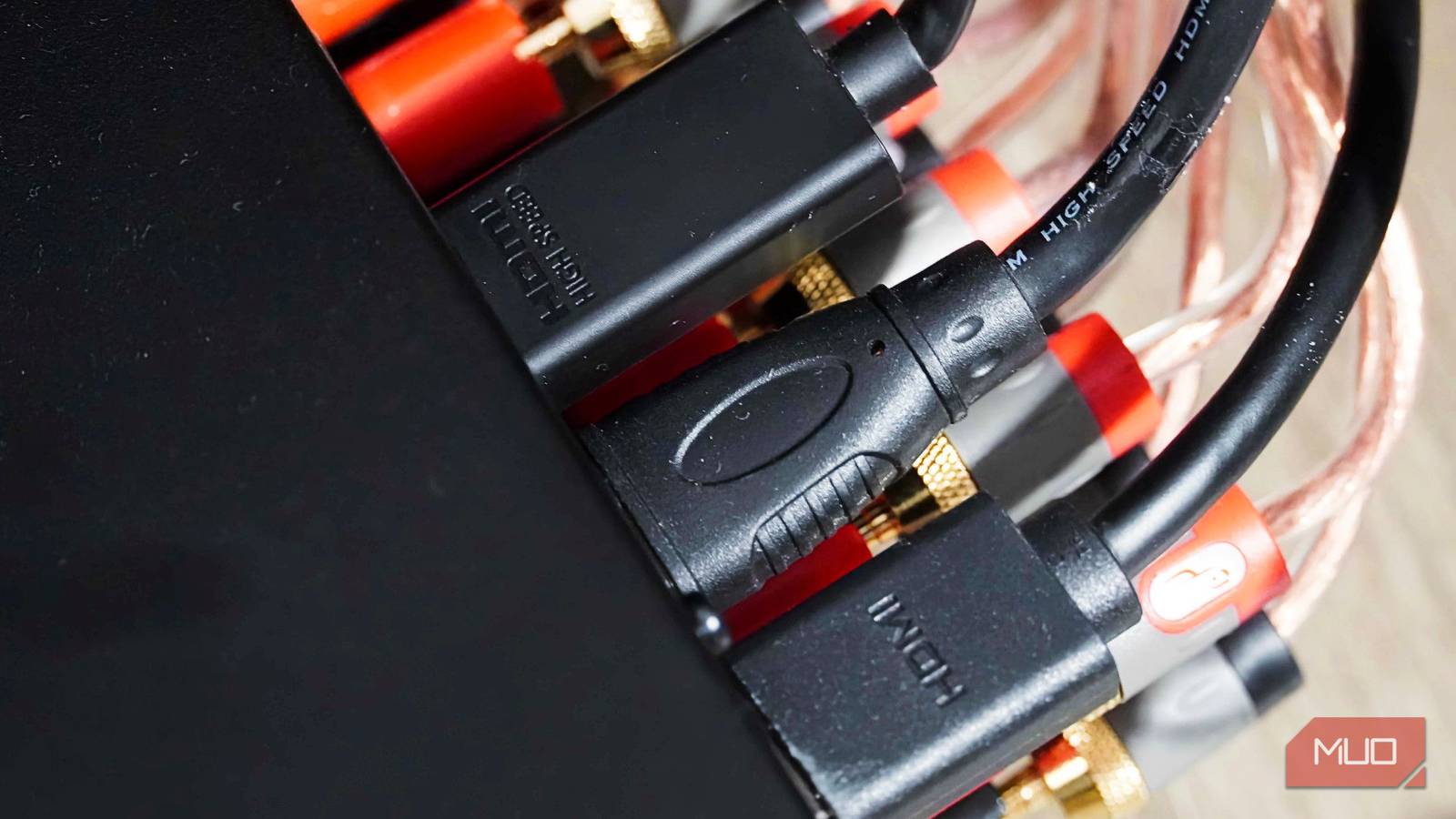
Most people buying an HDMI cable spend more time second-guessing themselves than they need to. The packaging is full of version numbers, different types, bandwidth specs, and premium branding that makes you think price is all that matters. That's not always true, though. Digital signal transmission doesn't work the way the marketing suggests, and once you understand why, the whole cable-buying decision gets a lot simpler.
Buying an expensive cable won't give you a better picture
HDMI cables either work or they don't
Back in the days of analog connections like composite video or VGA, signals traveled as continuous electrical waves, and those waves were sensitive to interference and resistance. A cheap or poorly made cable would slowly degrade the signal, leaving you with a dimmer picture, ghosting, or muffled audio. The cable's quality directly affected the output quality.
HDMI works completely differently. It's a digital interface, meaning it transmits data as ones and zeros rather than as a wave. So, where VGA is kind of in between good and bad, depending on the wave, HDMI is either good or bad. The signal either gets through or it doesn't.
This is the digital cliff effect. Either the data arrives intact, and your display reconstructs a perfect image, or the signal collapses, and you get blackouts, screen tearing, audio dropouts, or random flashing pixels. There's no in-between state where a cheaper cable quietly robs you of sharpness or color depth.
If your TV is showing a stable picture with no glitches, your cable is already doing its job perfectly. It literally can't do any better than that.
This is exactly why the premium cable market is built on shaky ground. A lot of high-end cable brands are trading on ideas left over from the analog era, suggesting that gold-plated connectors or exotic materials will give you warmer audio or a sharper picture.
In reality, a basic certified cable gives you the same image and audio as an expensive one. Fancy braiding, thick shielding, and gold connectors might make a cable more durable if you're constantly plugging and unplugging it, but they can't make a digital one or zero travel any better.
The only situations where cable quality genuinely starts to matter are over long distances or in environments with severe electrical interference. High-frequency signals do weaken over long cable runs, but it doesn't really matter if the cable is about six feet long.
A cheap cable and an expensive one are the same in that range. It's only when you're running a longer cable that the price actually matters.
Buy a cable that matches the hardware you already own
Most setups only need a cheap cable
When shopping for an HDMI cable, the best way to avoid overpaying is to know what your hardware actually needs. A lot of people go looking for version numbers on the box, like HDMI 2.0, HDMI 2.1, and that kind of thing.
What you should be looking for instead are the speed certification labels printed on the packaging, because the cable itself only controls how much data can travel through it. Everything else is determined by your source device and your display. Buying a cable that is better than what your equipment can actually do doesn't add anything; it just costs more.
Most people don't need anything fancy. If you're hooking up a 1080p office monitor or a basic HD TV, a cable with Standard or High Speed is all you need.
If you're stepping up to a 4K TV for streaming through a Roku, Apple TV, or a Blu-ray player, a premium high-speed cable is the right pick. These support 18 Gbps, which is plenty for 4K at 60Hz plus static HDR, and because they've been around for years, they're cheap. They usually go for under $15. Spending more than that for a standard 4K setup or an office monitor is genuinely pointless.
The only time you actually need to spend more is if you have cutting-edge gaming hardware or a high-end home theater setup. If you're running a PS5, an Xbox Series X, or a modern gaming PC and you want to get the most out of that hardware, you'll need an Ultra High Speed Cable.
These support 48 Gbps, which is what's required for 4K at 120Hz or 8K at 60Hz. That said, even here you don't need to go overboard. A certified Ultra High Speed cable that costs around $20 will be as good as a $100 cable over a normal living room distance.
Shoving your TV against the wall can ruin the wires
Long cables only work when you plug them in the right way
Even though digital signals are pretty tough, the actual copper wires inside an HDMI cable are surprisingly fragile. If you force a cable around a sharp corner or cram a wall-mounted TV back against the plug, you can easily mess up the internal wiring. Every HDMI cable has a minimum bend radius, and if you ignore that during installation, you're going to have problems.
Bending or kinking it too sharply throws off the precise spacing between the internal wire pairs, which will cause it to mess up when displaying your content. The thicker and heavier a cable gets, the more stress it puts on whatever it's plugged into. Letting a heavy cable hang freely off the back of a TV or receiver might seem harmless, but over time, the constant downward pull slowly bends the metal pins inside the port.
Once that happens, you end up with a loose connection that cuts out every time someone bumps into the entertainment center. The fix is simple: secure the cable to your TV mount or media console, so the weight isn't just hanging off the port.
Longer active HDMI cables and fiber-optic hybrid cables are directional. Regular short cables work fine either way, but these longer specialized ones have tiny chips built into the connector heads that boost the signal. They only work one way, though.
The end marked "Source" has to go into your player, and the one marked "Display" has to go into your TV. Running a fifty-foot cable backward through a ceiling is a painful mistake to realize, because it will pass absolutely no signal until you pull it out and flip it around.
Don't fall into the HDMI trap
For normal setups, though, the cheap cable from a reputable brand does the same job as the expensive one. Buy to match your hardware's actual output, secure the cable so it's not straining the port, and check the directional labeling on anything longer than a standard run. That's genuinely all there is to it.
Understanding the digital nature of HDMI helps consumers avoid marketing traps. The technology has been refined over decades: HDMI 1.0 launched in 2002, and since then, bandwidth has increased from 4.95 Gbps to 48 Gbps with HDMI 2.1. Each iteration brought support for higher resolutions and refresh rates, but the fundamental principle of digital transmission remains unchanged. The cable is a conduit for data, not a component that enhances quality. Factors like cable construction, shielding, and connector quality only become critical when distances exceed 50 feet or when running cables near power lines or other sources of electromagnetic interference. For most home users, a certified cable from a reputable brand at a reasonable price is all that's needed. The HDMI Licensing Administrator provides certification programs that ensure cables meet minimum performance standards. Look for the official certification logo on the packaging to guarantee compatibility and performance. This simple step eliminates guesswork and ensures you get exactly what you need without paying a premium for branding or unnecessary features.
Source:MakeUseOf News