
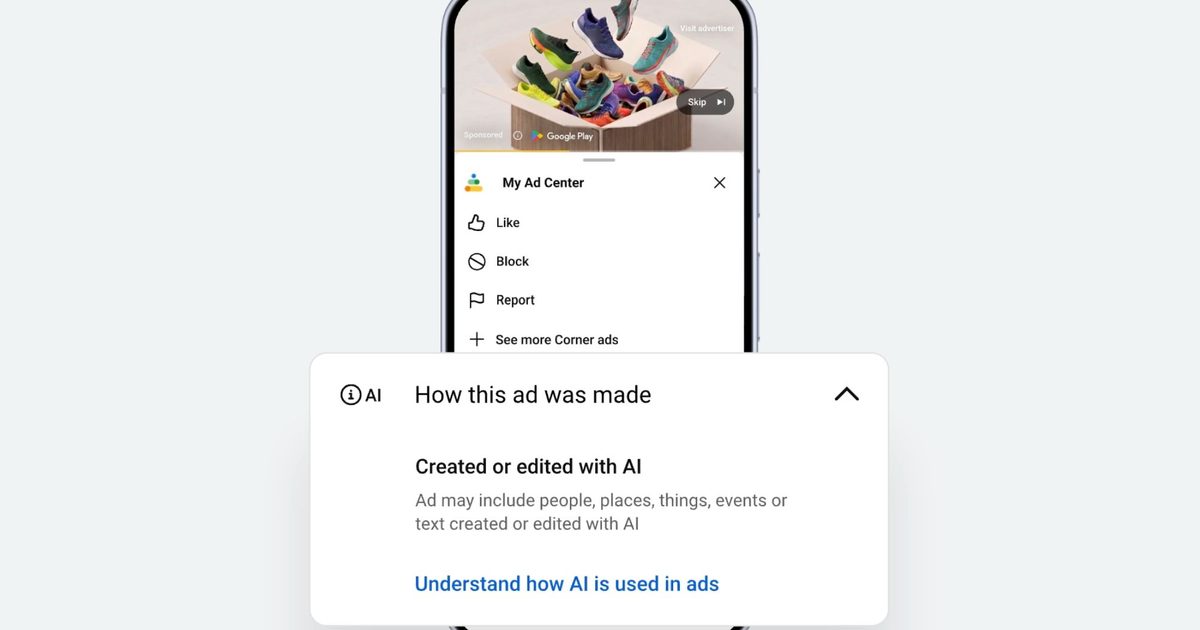
Have you ever scrolled through an ad and wondered whether it was crafted by a human hand or generated in seconds by an AI? Google is giving users a way to find out. The company recently announced a new AI transparency label that informs viewers whether an advertisement was created or edited using generative AI tools. This label lives inside Google's My Ad Center, and it is rolling out globally across Google Search, YouTube, and Discover.
The label is designed to address a growing challenge in digital advertising: the blurring line between human-created content and AI-generated material. As generative AI models become more sophisticated, ads can now include photorealistic images, lifelike videos, and compelling copy that may not be obviously automated. Google's label aims to restore some of that clarity for users, giving them context about how the ad was produced.
How to find the AI label on Google ads
Finding the label is straightforward. When you encounter an ad on Google Search, YouTube, or Discover, tap the three-dot menu or the info button typically located near the ad. A section titled "How this ad was made" will appear. If the ad was created or edited using AI, you may see a label reading "Created or edited with AI." This information is embedded within the ad's transparency details, which already include data about why you are seeing a particular ad and which advertiser is behind it.
For ads generated using Google's own generative AI advertising tools—such as those created through Performance Max campaigns using AI-driven asset generation—the label is applied automatically. This means users do not need to rely on advertisers to voluntarily disclose their use of AI. However, if an advertiser uses a third-party AI tool (for example, a standalone image generator or video editor), they have the option to manually disclose that information through My Ad Center. In some countries, local regulations may also require AI labels to appear directly on the ad creative itself, independent of the disclosure menu.
Why Google is adding AI labels
The rapid advancement of AI-generated images and videos has made it increasingly difficult to distinguish between content produced by humans and that generated by algorithms. This has significant implications for consumer trust and advertising effectiveness. If users cannot tell whether an ad's imagery or messaging was artificially generated, they may feel misled or skeptical about the brand behind it. Google's label is intended to provide transparency and help advertisers keep pace with evolving industry standards and consumer expectations.
This initiative builds on a broader set of Google transparency efforts. The company has already introduced mandatory disclosures for digitally altered political ads, requiring advertisers to reveal when an ad uses synthetic content that portrays realistic events or people. Additionally, Google has expanded support for technologies such as SynthID—an invisible watermarking system for AI-generated images—and C2PA, a content provenance standard that helps trace the origin of digital media. SynthID is already used in Google Photos to watermark AI-edited images, and C2PA is being integrated into Google Messages to help identify AI-generated images in chat conversations.
Beyond ads, Google is testing methods to show AI-generated image labels directly in Google Search results. The company has also expanded Gemini's ability to help users spot AI-generated videos. The new ad labels are a natural extension of these efforts, bringing the same level of transparency to commercial advertising that the company is pursuing in other areas of its ecosystem.
What this means for advertisers and consumers
For advertisers, the new label introduces both opportunities and obligations. Brands that use Google's AI tools to generate ad assets will have the label applied automatically, which may help build trust with consumers who appreciate knowing the technology behind the content. However, advertisers using third-party AI tools must decide whether to manually disclose that information. Failure to do so could lead to consumer backlash if users later discover undisclosed AI usage, especially in contexts where authenticity matters—such as testimonials, before-and-after images, or product demonstrations.
From a consumer perspective, the label empowers users to make more informed judgments about the ads they see. Knowing that an image or video was generated by AI may influence how much trust a viewer places in the claims being made. For example, a travel ad showing a pristine beach might be less persuasive if the beach is entirely AI-generated rather than a real photograph. The label also assists users in developing a general awareness of the prevalence of AI in advertising, which is likely to increase in the coming years.
The rollout also raises questions about privacy and user control. My Ad Center is part of Google's larger effort to give users more transparency and control over the ads they see. The AI label fits into that framework by adding another dimension of information. However, users should note that the label does not reveal the specific AI model used or the extent of the AI involvement—only that the ad was created or edited with generative AI. This broad categorization may be sufficient for most users, but it leaves some nuance unaddressed, such as whether a human editor significantly modified the AI output.
Broader industry context and future developments
Google's move is part of a wider trend in the tech industry toward AI transparency. As generative AI becomes embedded in more products—from social media filters to customer service chatbots—companies are exploring ways to label synthetic content. Meta, for example, has developed an invisible watermarking tool called Content Seal for images generated by its Muse AI, though detection tools have struggled to identify all instances. Other platforms are experimenting with metadata tags and cryptographic signatures to prove content origin.
Regulators are also paying close attention. The European Union's AI Act, for instance, includes provisions for transparency obligations around AI-generated content, and several countries are drafting laws that require labeling of synthetic media in commercial communications. Google's voluntary adoption of AI labels, particularly for its own tools, positions the company to comply with emerging regulations while shaping industry norms. The fact that the label can appear both in the My Ad Center menu and directly on the ad creative in certain jurisdictions suggests a flexible approach that can adapt to varying legal requirements.
Looking ahead, Google is likely to refine the labeling system as more advertisers use generative AI tools. The company is already testing ways to surface AI-generated image labels within Google Search itself, independent of ads. Additionally, the expansion of Gemini's capabilities to identify AI-generated videos indicates that Google sees AI detection as a long-term strategic priority. The new ad labels serve as an immediate step toward a future where consumers can routinely distinguish between human-made and AI-generated media across the digital landscape.
Source:Digital Trends News