

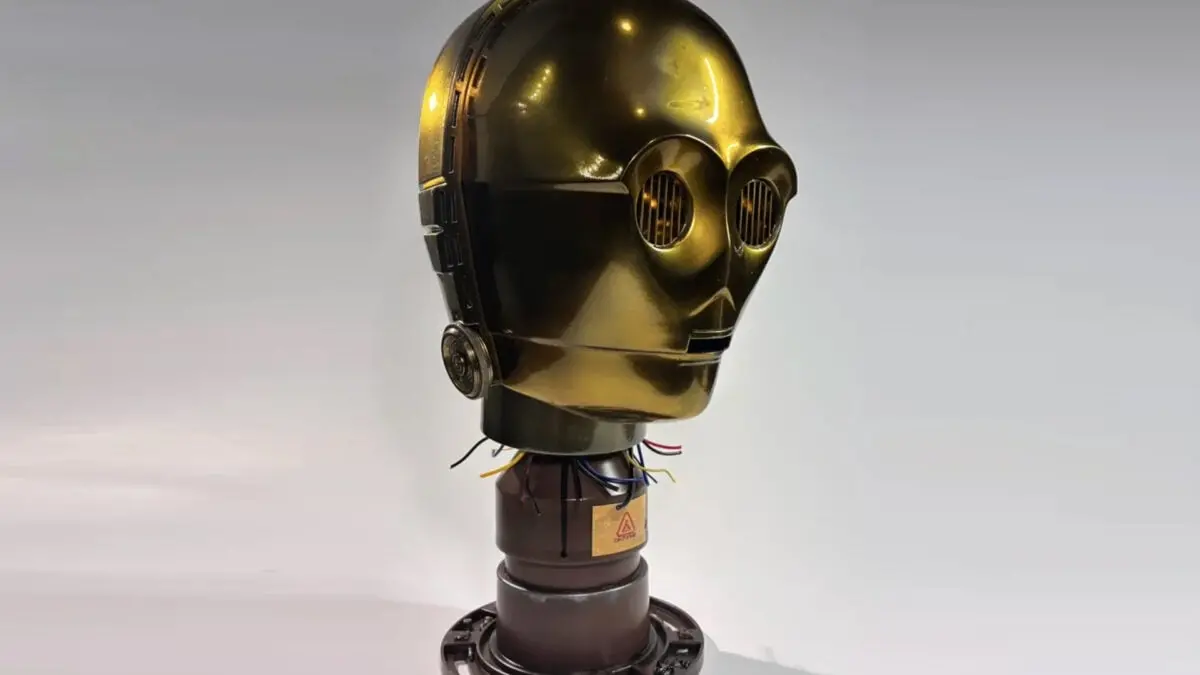
For Star Wars Day, enthusiasts often celebrate the iconic characters that defined the galaxy far, far away. Among them, C-3PO—the fastidious golden droid with the demeanor of a disapproving butler—rarely gets the spotlight. Yet a new DIY project changes that, allowing anyone to bring Threepio to life with a combination of artificial intelligence, a Raspberry Pi 5, and a custom language model trained to mimic the droid's prissy personality.
Samuel Potozkin, a student at Chapman University in Orange County, California, recently shared a video detailing how he constructed a fully functional C-3PO head that can hold a conversation. The head's speech capabilities are powered by a pipeline: a microphone captures the user's speech, which is converted to text via real-time speech-to-text. That text is sent as a prompt to a custom large language model (LLM) imbued with C-3PO's distinctive character traits. The LLM's response is then fed into a text-to-speech system that emulates Threepio's signature vocal delivery—complete with metallic resonance and slight modulation.
The project emerged from a combination of fandom and technical curiosity. Potozkin notes in a paper published on his GitHub page that the initial text-to-speech output lacked the metallic tone associated with C-3PO. To fix this, he applied audio post-processing reminiscent of a guitarist's pedalboard: a short delay line created tightly spaced temporal reflections, and a chorus effect was added by slightly modulating the time and pitch of duplicated signal paths. The result is a voice that sounds strikingly close to the original, even when emanating from a disembodied head prop.
The head itself is built around a Raspberry Pi 5, a small single-board computer powerful enough to handle real-time speech conversion and LLM inference. The custom LLM was trained on a corpus of C-3PO dialogue from the Star Wars films, as well as additional text that reinforces the character's pedantic and slightly anxious nature. Potozkin emphasizes that the model's responses are not perfect but are deliberately kept in character, making the interaction feel authentic—even when the droid responds with a flustered complaint about your questions.
This project is the latest in a wave of DIY Star Wars creations that merge AI with fandom. Earlier this year, a fan built a working R2-D2 that could navigate rooms using computer vision, and another group created a life-size BB-8 that rolled around a convention hall. But the C-3PO head stands out because it focuses on personality and conversation rather than mobility. It offers a unique experience: you speak into the microphone and receive a reply in Threepio's voice—effectively making you feel like R2-D2, the bleeping astromech who communicates only through electronic sounds.
The timing of the project is also notable. Last month, the original C-3PO head prop from The Empire Strikes Back sold at auction for over $1 million, one of the highest prices ever paid for a Star Wars artifact. That head—the one that is separated from C-3PO's body when he wanders through the wrong door in Cloud City—has become a legendary piece of movie memorabilia. Potozkin's creation, while not an exact replica, captures the spirit of that prop and makes it accessible to anyone with basic electronics skills and a 3D printer.
For those interested in building their own, Potozkin's GitHub repository provides a complete guide, including STL files for the head casing, wiring diagrams for the Raspberry Pi, and all the code needed to set up the LLM and speech processing. The project requires a Raspberry Pi 5, a microphone, a speaker, and a 3D printer. The total cost is estimated at around $200, making it far more affordable than acquiring the original auction piece.
The use of AI in recreating fictional characters raises interesting questions about authenticity and emotion. Potozkin's approach deliberately avoids making the head feel too human-like; the metallic tone and occasional stutter are part of the charm. The AI is not trying to trick you into thinking you are talking to the real C-3PO—it's a toy that amplifies the fun of being a Star Wars fan. It also demonstrates how far consumer-grade AI and hardware have come: a student can now build a conversational droid that would have seemed like magic just a decade ago.
Beyond the novelty, the project is a showcase for several technical disciplines. The speech-to-text component relies on open-source models that run locally on the Raspberry Pi, ensuring privacy and low latency. The custom LLM was fine-tuned using a technique called LoRA (Low-Rank Adaptation), which allows efficient training of a character-specific model without requiring massive amounts of data. The audio post-processing uses digital signal processing (DSP) techniques that are common in music production but rarely applied to voice synthesis for character replication.
Moreover, the project has sparked a community of tinkers who are now adapting it to other characters. Forums are already discussing how to build a talking Yoda head (using inverted sentence structure) or a sarcastic K-2SO from Rogue One. The underlying architecture is modular, so swapping in a different personality is just a matter of replacing the LLM and adjusting the voice parameters. Potozkin has released his work under an open-source license, encouraging others to remix and improve upon it.
One of the more surprising aspects of the project is how it handles emotional nuances. Because C-3PO is a character who expresses constant anxiety and exasperation, the LLM was trained to detect emotional cues in the user's speech and respond appropriately. For example, if the user sounds frustrated, the head might reply with a peevish complaint about being bothered. This adds a layer of interactivity that goes beyond simple question-and-answer, making each conversation feel unique.
The hardware setup is straightforward: the Raspberry Pi 5 connects to a USB microphone and a powered speaker. The head itself is mounted on a custom stand that allows for slight rotational movement, controlled by a small servo. Potozkin is working on adding a second servo for nodding, which would make the droid seem more attentive. Power is provided via USB-C, and the entire unit is compact enough to sit on a desk or shelf alongside other collectibles.
Testing the head in everyday settings reveals its strengths and limitations. In quiet environments, the speech recognition works reliably; in noisy rooms, it can struggle, but Potozkin has noted that adding a noise-canceling microphone improves performance. The response time is about one second, which feels natural for conversation. The AI occasionally misinterprets words, leading to amusing non-sequiturs—which, in many ways, is exactly how C-3PO would behave.
The project has garnered attention from tech blogs and Star Wars fan sites, partly because it taps into the enduring appeal of the franchise and partly because it demonstrates the practical application of LLMs for character-driven interactions. It also serves as an educational tool: the GitHub repository includes a detailed explanation of the neural network architecture and the DSP pipeline, making it a valuable resource for students learning about AI and audio engineering.
As Star Wars Day celebrations continue to evolve, DIY projects like this one invite fans to engage with the universe in a hands-on way. Rather than just watching the movies or buying merchandise, builders can create something that actively interacts with them. Potozkin's talking C-3PO head is a perfect example of how technology can transform passive fandom into an immersive, creative experience. Whether you're a seasoned maker or a novice just learning to code, the project provides a clear path to building your own piece of the galaxy.
With May the Fourth now giving way to deeper explorations of what AI can do for storytelling and character recreation, one thing is certain: the Force of innovation is strong with this one. And the next time you need a golden droid to pass comment on your life, you can simply build one.
Source:Gizmodo News