

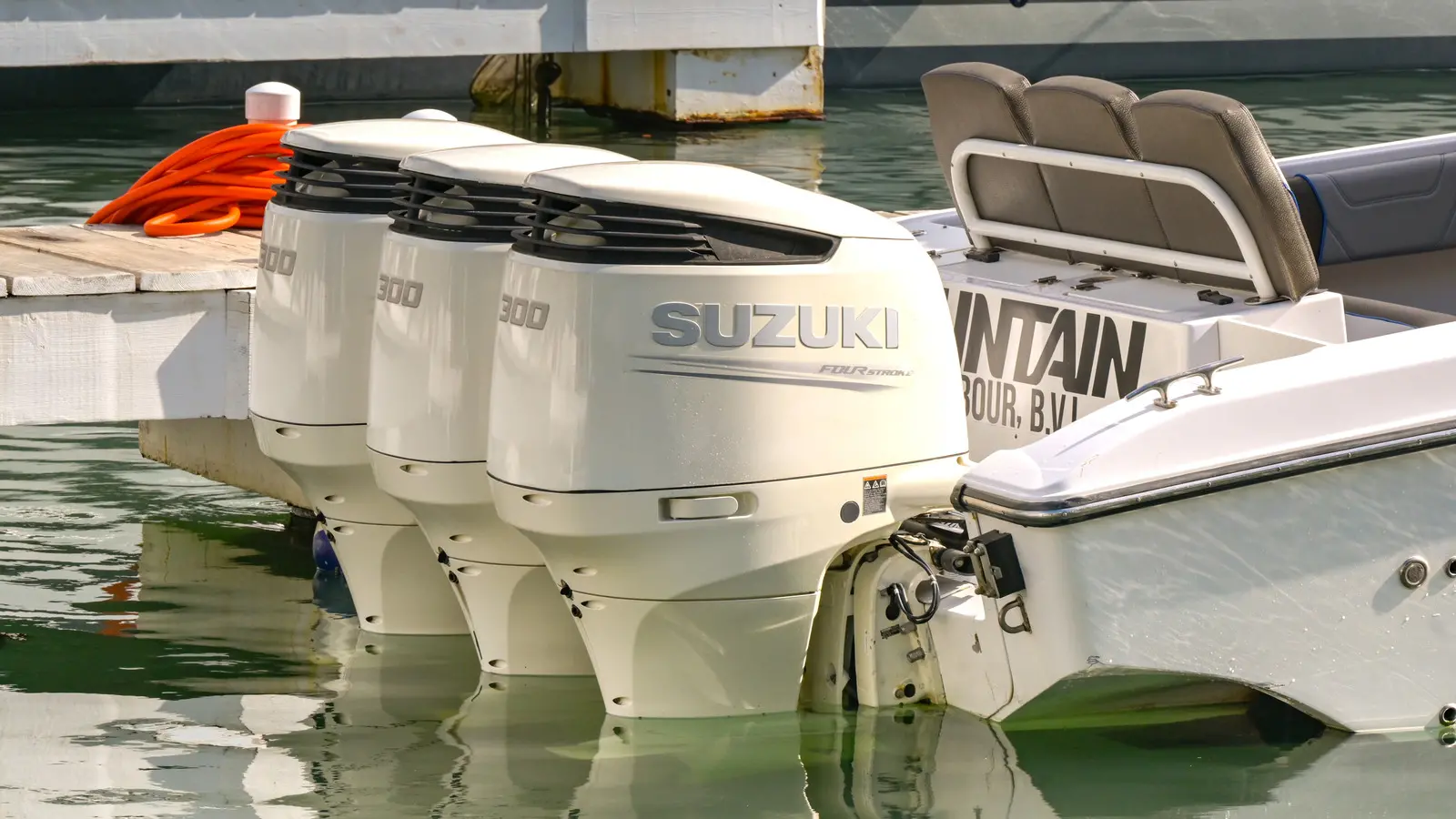
Buying a boat involves a long list of decisions, and few matter more than the type of engine that will push the vessel through the water. Boaters generally choose between four configurations: outboard motors, inboards, stern drives, and jet drives. An outboard motor is exactly what its name suggests — the entire powerplant, from the powerhead down to the lower unit and propeller, is mounted on the outside of the transom rather than tucked inside the hull.
That exterior placement is the source of nearly every outboard advantage. Because the engine sits outside the hull, boatbuilders can devote more interior space to seating, storage, and living areas. Some hulls can also carry two, three, or even four outboards, delivering a combined output that a single stern drive struggles to match. For anglers, families, and anyone who prizes deck space, the appeal is obvious.
The trade-offs, however, are just as real. Outboards are more exposed to the elements, they can be louder, they impose hard limits on certain water sports, and their rear-mounted position creates practical and aesthetic frustrations for some owners. Below is a detailed look at four key disadvantages, along with the context you need to judge whether they actually matter for the kind of boating you plan to do.
How the outboard motor became a boating staple
The first commercially successful outboard was introduced in 1909 by Ole Evinrude, a Wisconsin machinist who built a small single-cylinder engine that could be clamped to the back of a rowboat. It weighed roughly 60 pounds and produced about 1.5 horsepower, yet it freed boaters from oars and sails in a way that had never been practical before. Within a few decades, outboards had become the default power source for small craft around the world.
Early units were almost universally two-stroke engines, valued for their simple design, low weight, and high power-to-weight ratio. Tightening emissions rules in the United States eventually pushed the industry toward cleaner four-stroke and direct-injection two-stroke designs, and modern outboards now routinely feature electronic fuel injection, digital throttle control, variable valve timing, and integrated vessel control systems. Those engineering advances have narrowed several of the historical gaps between outboards and inboards, but they have not eliminated the structural drawbacks that come with hanging an engine off the back of a boat.
1. Outboard motors are more vulnerable to corrosion
This is perhaps the most obvious disadvantage of an outboard motor. Because it is not located within a boat's hull, it is naturally exposed to everything the water and weather can throw at it. If an owner neglects proper maintenance, prolonged and frequent exposure to salt water can result in corrosion of the lower unit, mounting bracket, fasteners, and even the internal cooling passages.
Owning a boat with an outboard motor means committing to a certain degree of upkeep. In practice, that looks like a routine that begins the moment the boat comes out of the water.
What routine outboard care actually involves
- Rinse the exterior of the outboard with fresh water after every trip, paying particular attention to the lower unit and any exposed metal.
- Flush the cooling system according to the manufacturer's manual, using earmuffs or a flush port, to purge salt, sand, and silt from the water jackets.
- Wash gently with mild soap and products formulated specifically for outboard motors rather than harsh solvents that can strip protective finishes.
- Inspect the anodes — the sacrificial zinc or aluminum blocks designed to corrode before the engine's own metal does — and replace them as they deteriorate.
- Coat electrical connections and linkages with a corrosion inhibitor, and check the propeller shaft for fishing line, which can cut seals and allow water into the gearcase.
- Store the engine tilted or in the position the manual recommends so that water drains properly and does not pool.
Accounting for maintenance needs is essential when purchasing any vessel. A buyer who is not prepared for a regular rinse-and-flush routine should recognize that keeping an outboard-powered boat in good condition will be more demanding than maintaining a comparable boat with an inboard motor, where the engine is shielded inside the hull. In saltwater regions, that difference in effort compounds over the years and directly affects resale value.
2. Outboard motors may be louder than other options
Thinking about the type of boating experience you want is essential when deciding what kind of boat to purchase. If your ideal afternoon involves calm, quiet water and easy conversation at low speed, an older outboard may work against that goal. Outboards are often louder than inboard engines, largely because the powerhead sits above the waterline and radiates sound directly toward the cockpit rather than being muffled by a sealed engine compartment.
That is not a universal rule. It is worth considering how technological improvements have addressed weaknesses historically associated with certain motors. Newer four-stroke outboards, in particular, are dramatically quieter than the carbureted two-strokes of previous generations, and many modern models include sound-dampening cowlings, tuned exhaust systems, and idle-relief features that make trolling or docking far more pleasant. Some contemporary outboards are also more powerful than earlier designs of the same weight, which is one reason outboards have become increasingly popular in recent years.
Whether you are buying a used boat or a new vessel, the age of the motor tells you a lot about its features. A twenty-year-old two-stroke and a current-generation four-stroke are entirely different propositions in terms of noise. The presence of an outboard motor could mean a boat will be too loud for your tastes, but that is not a guarantee if the motor is relatively new. Learning the specific model you are considering — its displacement, induction system, and rated decibel output at cruise — is the only reliable way to know.
3. Outboard motors are not safe for certain activities
It is important to take into account the boating activities and water sports you want to pursue when shopping for the right vessel. An outboard motor may simply be the wrong choice if you plan to enjoy sports such as wakesurfing.
This popular activity involves surfing on the wake generated behind a boat, typically at speeds of roughly 9 to 12 miles per hour with heavy ballast used to build a large, steep wave. It is also exceptionally unsafe when the boat has an outboard motor. In an outboard configuration, the surfer rides directly behind the transom, very close to a spinning propeller that stays engaged for the entire session. Falling forward toward the boat — a common occurrence — puts the rider at significant risk of injury from the prop or the lower unit. In fact, depending on where you boat, wakesurfing behind an outboard may even be prohibited by local regulations or insurance policies.
The same geometry affects other activities. Tubing and wakeboarding behind an outboard require longer tow lines and careful driver discipline, because riders can swing toward the engine when the line goes slack. Boarding from the water near a running engine demands extra caution as well. Familiarizing yourself with boating safety should be among your top priorities when buying your first boat, and that includes understanding how motor layout shapes what you can safely do on the water. If you want to enjoy certain aquatic activities, an inboard or a forward-mounted engine with the propeller tucked well under the hull may be the safer platform.
4. Outboard motors' location is inconvenient for some boaters
There are several reasons some boaters consider the exterior, rear location of an outboard motor to be an inconvenience. One is the swim platform. A boater who wants a wide, unobstructed platform for lounging, swimming, or boarding from the water will find that an outboard occupies exactly the square footage they hoped to use. With an outboard, it can be difficult — sometimes impossible — to lounge in that area, and reboarding near a tilted engine requires care. Inboards and stern drives keep that space relatively clear.
There are also boaters who simply dislike the look of an outboard. They may feel that a large black or white cowling hanging off the transom detracts from a vessel's lines enough that they want a different power option altogether. Others object to the reduced visibility aft, particularly when running a center console with a tall engine block sitting in the sightline.
Storage and trailering considerations follow the same logic. An outboard adds length to the overall towing package and increases the height a boat must clear in a garage or rack storage facility. For owners who keep their boats on trailers and launch frequently, though, the same exterior mounting that causes inconvenience makes servicing easier — the entire engine can be tilted, removed, or replaced without opening up a hull.
How outboards compare with inboards, stern drives, and jet drives
Placing the four disadvantages in context helps. Each engine configuration concentrates its trade-offs in a different place:
- Outboard: maximum deck space, easy replacement and servicing, strong power-to-weight ratio; exposed to corrosion, generally louder, hazardous for surfing sports, and occupies the transom.
- Inboard: protected engine, quieter operation, clean swim platform, ideal for wakesurfing; consumes interior space, harder to access for service, and typically heavier.
- Stern drive: a compromise that hides the engine inside the hull while keeping the drive unit outside; still exposes the outdrive to corrosion and adds mechanical complexity through the transom seal.
- Jet drive: no exposed propeller, shallow-water capability, and safer for riders in the water; less efficient at cruise, prone to ingesting debris, and expensive to repair.
None of this is meant to suggest that outboard motors are always undesirable. They are not free of disadvantages, but for a great many boaters they represent the superior engine style — particularly for anglers who want open cockpit space, owners in warm climates who trailer their boats, and anyone who values the simplicity of lifting an entire engine off the transom when it needs replacement.
Matching the motor to the mission
Ultimately, a vessel's motor will play a major role in the boating experience, shaping everything from how much deck space you have to how easily you can hold a conversation at anchor. Rather than ranking engine types in the abstract, the more useful exercise is to list the ways you actually plan to use the boat — fishing, cruising, watersports, overnighting, entertaining — and then ask how each disadvantage would show up on that list.
A wakesurfing family will find the propeller exposure of an outboard disqualifying. A coastal angler who rinses and flushes after every trip will barely notice the corrosion penalty. A buyer shopping a freshwater lake with a modern four-stroke will likely find noise a non-issue, while someone restoring a classic hull may find the aesthetic objection decisive. Sorting the four drawbacks by which ones you can live with is a faster path to the right boat than trying to find a motor without any.
Because these trade-offs are specific to hull design, local water conditions, storage arrangements, and insurance requirements, a conversation with a dealer or marine surveyor before signing is worthwhile. A surveyor, in particular, can assess the condition of an existing outboard's anodes, seals, and compression, which often reveals more about a boat's true cost of ownership than the engine type listed on the spec sheet.
Source:SlashGear News