

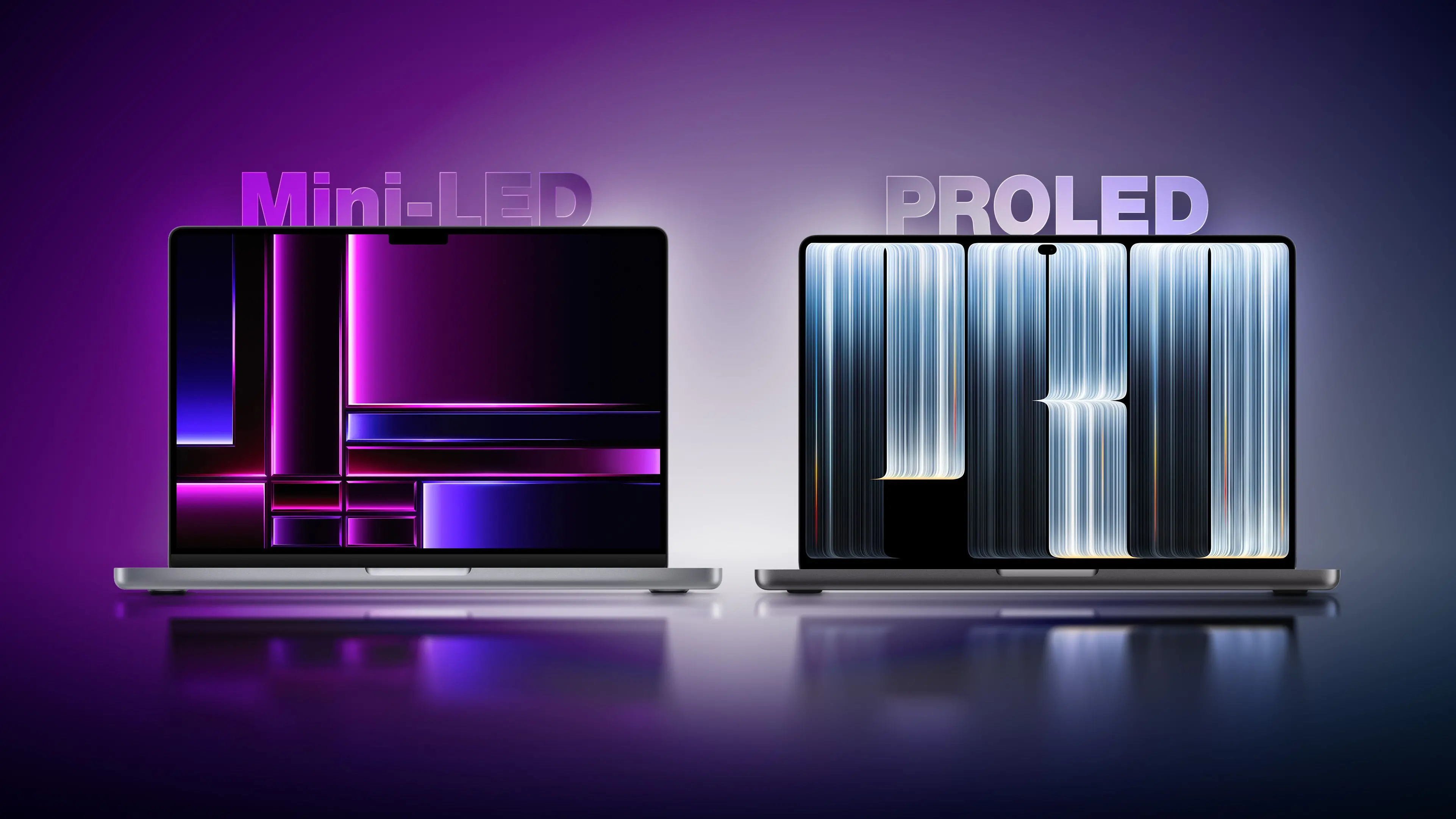
Apple has expanded the MacBook Pro family with a new PROLED XDR model that brings tandem OLED technology, touchscreen input, the Dynamic Island, and a thinner, lighter design. It sits alongside the Liquid Retina XDR versions introduced in March 2026, and both lines use the same M5 Pro and M5 Max chips. The PROLED versions carry a $400 starting-price premium across equivalent sizes and chip tiers. The 14-inch M5 Pro starts at $2,499 with Liquid Retina XDR or $2,899 with PROLED XDR, while the 16-inch models start at $2,999 and $3,399. Because chip options, memory capacities, and battery life are unchanged, the decision centers on the display, touch interaction, and portability.
Headline and key facts
- Apple now offers two MacBook Pro display paths: Liquid Retina XDR mini-LED and PROLED XDR tandem OLED.
- The PROLED XDR model adds touch input, Dynamic Island, a slimmer design, and a $400 starting premium.
- Both versions share M5 Pro and M5 Max chips, memory capacities, and battery life ratings.
- The Liquid Retina XDR models launched on March 11, 2026, while the PROLED XDR models launch on November 6, 2026.
- The most visible gains are in contrast, peak brightness, color gamut, reference modes, weight, audio, storage, and external-display support.
Display technology and image quality
The Liquid Retina XDR MacBook Pro uses a mini-LED-backlit LCD with local dimming. Its backlight is divided into zones, so dark areas can dim while bright areas remain lit. The PROLED XDR MacBook Pro moves to tandem OLED with two self-illuminating pixel layers. That means individual pixels produce their own light rather than relying on a zone-based backlight. The OLED panel also includes a dedicated display engine that compensates for content, temperature, environment, and individual pixel usage over time.
The contrast ratio rises from 1,000,000:1 on the Liquid Retina XDR to 10,000,000:1 on the PROLED XDR. Peak HDR brightness increases from up to 1,600 nits to up to 2,000 nits. For SDR use, the Liquid Retina XDR reaches up to 1,000 nits outdoors, while the PROLED XDR reaches up to 1,000 nits sustained full-screen SDR brightness and up to 2,000 nits peak outdoor SDR brightness. The PROLED panel covers P3 and Adobe RGB wide color gamuts, compared with P3 only on the Liquid Retina XDR.
Resolution changes slightly. The 14-inch Liquid Retina XDR has a 14.2-inch display at 3024 by 1964, while the 14-inch PROLED XDR has a 14.2-inch display at 3024 by 1986. The 16-inch Liquid Retina XDR has a 16.2-inch display at 3456 by 2234, while the 16-inch PROLED XDR has a 16.3-inch display at 3472 by 2266. Both retain a 254-pixel-per-inch density.
The physical display assembly also differs. Liquid Retina XDR models have wider display borders and a camera notch. PROLED XDR models have slimmer display borders and a smaller camera cutout with the Dynamic Island. The Liquid Retina XDR has rounded top display corners and square bottom corners, while the PROLED XDR has rounded corners at all four corners. The Liquid Retina XDR uses a standard display or an optional nano-texture display. The PROLED XDR adds an antireflective coating and a fingerprint-resistant oleophobic coating, and it still offers optional nano-texture cover glass.
Touch is a major structural change. The PROLED XDR has a Multi-Touch sensor integrated directly into the display panel rather than layered on top, which Apple says reduces latency and bulk. Both versions deliver up to 1,000 nits of sustained full-screen HDR brightness, so the PROLED panel's 2,000-nit peak does not mean it is twice as bright across every task. Both also retain a 1-nit minimum brightness, True Tone, support for one billion colors, and 254 pixels per inch.
Reference modes and color workflows
The reference-mode lists show where the PROLED XDR is aimed at production work. The Liquid Retina XDR includes Apple XDR Display at P3-1600 nits, Design and Print at P3-D50, and Photography at P3-D65. The PROLED XDR includes Apple XDR Display at P3-2000 nits, plus Apple XDR Display at P3 and Adobe RGB-2000 nits. It also adds Design and Print at Adobe RGB-D50, Photography at Adobe RGB-D65, HDR Photography at P3-D65, and Medical Imaging at DICOM-600 nits for nondiagnostic review, research, and education.
The Liquid Retina XDR offers Medical Imaging at DICOM-350 nits for the same nondiagnostic uses. The PROLED XDR also adds Apple Color Matching Function 2026 for visual consistency with iPhone 18 Pro and Studio Display XDR. Both versions retain reference modes for HDR video, broadcast television, digital cinema, and sRGB workflows, and both support Pro Display Calibrator.
Design and dimensions
The weight reduction is more substantial than the change in thickness. For the 14-inch models, height falls from 1.55 cm to 1.50 cm, a 3.2% reduction; width falls from 31.26 cm to 31.08 cm, a 0.6% reduction; and depth falls from 22.12 cm to 21.63 cm, a 2.2% reduction. The 14-inch M5 Pro drops from 1.60 kg
Source:MacRumors News