

Last year, Microsoft’s 13-inch Surface Laptop quickly became one of the most recommended thin-and-light Windows notebooks. At $900, it offered MacBook Air–like build quality and battery life, making it an easy pick for anyone wanting a premium Windows experience without breaking the bank. But that was last year.
This year, due to a global RAM shortage, that same laptop costs $950 — and now that price gets you half as much RAM. Just 8GB. It’s the same great hardware on the outside, but the internal configuration has taken a severe hit. And as our testing reveals, even Microsoft cannot make Windows 11 run well on 8GB of RAM.
The Hardware: Same Great Build, Compromised Performance
The 2026 Surface Laptop 13-inch retains all the physical attributes that made its predecessor so appealing. The keyboard is nice and tactile, the trackpad is smooth and responsive (only outdone by models that allow corner-to-corner clicking), the 1080p webcam is sharp and clear, and the battery life remains excellent — easily lasting 10 hours on a charge. The processor, an eight-core Snapdragon X Plus (X1P-46-100), is nearly identical to the chip in last year’s model, with a slightly faster boost speed. In the 2025 version, that processor was a solid performer, capable of handling light photo editing in Lightroom Classic.
But last year's model had 16GB of RAM. That makes all the difference.
While the 8GB Surface Laptop was usually fine for basic web browsing or video streaming, any slight nudge toward multitasking caused immediate problems. During a Microsoft Teams call using the app (not browser), the host streamed a brief video, and the whole laptop hung for several seconds. At that time, I had about 10 Chrome tabs open across two desktops, alongside Slack and Signal — not an obscene level of multitasking. And nobody had their webcams on.
The Surface Laptop would hang for a few seconds several times a day, even when I thought I wasn’t pushing it too hard. I experienced these temporary freezes while just working in Google Docs — no Teams call or streaming in the background. It’s only a couple of times a day on average, but that’s still too often for a brand-new $950 laptop.
Memory Usage: Always Near the Limit
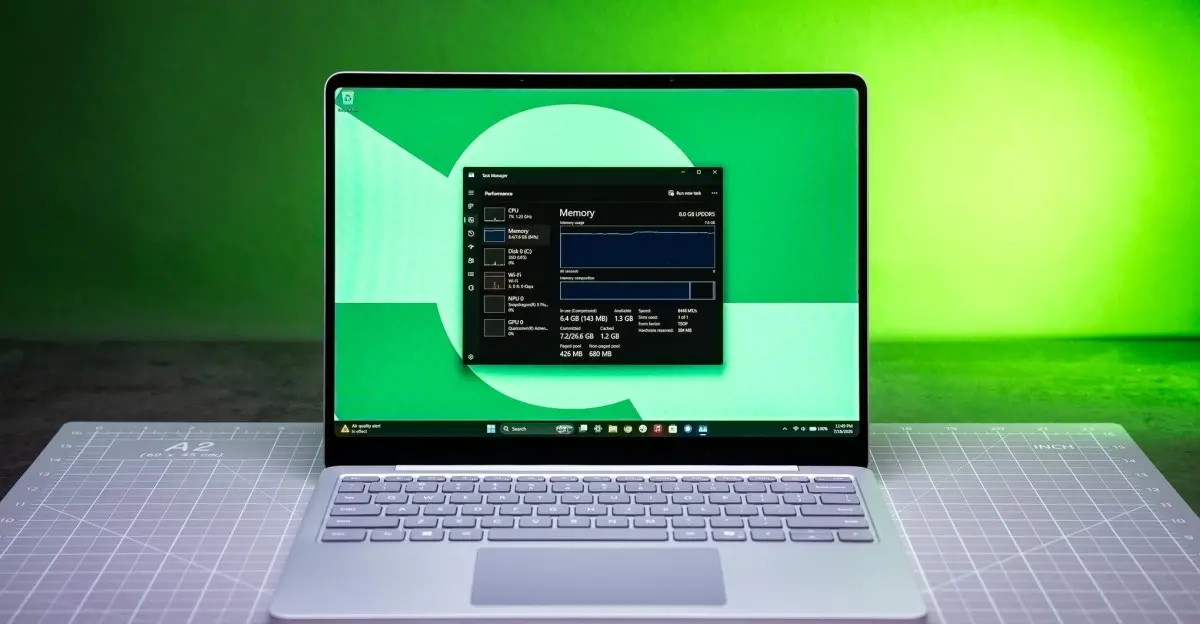
Keeping the Task Manager’s Performance tab open showed I was almost always using around 6.7GB of the available 7.6GB of usable memory. After a fresh reboot with bare minimum startup apps, Windows 11 itself was using 4.2GB of RAM. That's around the minimum Microsoft requires just to run the operating system, highlighting how little headroom remains with 8GB.
Limiting myself to about six Chrome tabs, closing Signal, and refraining from using any virtual desktops kept memory usage to about 5.5GB. But that kind of cautious behavior is unreasonable for a modern laptop. Is this workable for light loads? Yes. Do we want to live our lives being super cautious about how many apps we run and tabs we leave open on a new $950 laptop? Absolutely not. And if it’s choking on day one, how usable will it be in five years?
The RAMageddon: A Global Crisis
The decision to cut RAM is not limited to Microsoft. The entire tech industry is facing a severe memory shortage, often called “RAMageddon.” Prices for DRAM and NAND flash have skyrocketed due to increased demand from AI data centers, smartphone manufacturers, and automotive sectors. This has forced PC makers to reduce memory configurations in entry-level laptops to keep prices from soaring even higher.
At the recent Computex show, announcements from Dell, Acer, and Asus revealed upcoming laptops with 8GB of memory — a configuration we haven’t reviewed in over three years. With the RAM shortage likely to persist for years, we will see more and more 8GB offerings so manufacturers have something “entry-level” to offer. But if even Microsoft cannot make a Windows laptop run well on 8GB RAM, what hope do other OEMs have?
Comparison with MacBook Neo
The MacBook Neo also starts with 8GB of RAM, but macOS handles memory more efficiently. In testing, the Neo could handle more multitasking without the same level of stuttering. A Neo won’t have the shelf life of a higher-end MacBook Air, but it costs $250 less than the Surface Laptop (even after Apple’s recent price increase). That makes the Surface Laptop a tough sell.
What This Means for Windows Laptops
Microsoft has claimed its focus this year is improving Windows 11 performance and making it more reliable, especially for lower-cost hardware, to compete with the Neo. But our test results show there is still a lot of work to be done. It’s ironic that Microsoft needs to address this problem when it is one of the major perpetrators of the ongoing RAM crunch — driven by its massive AI investments.
Perhaps Microsoft does not care that its flagship Surface line will suffer for its AI obsession, but it still sucks to see. The 13-inch Surface Laptop initially offered respectable tradeoffs for a fair discount — “a little less for a little less,” as noted in last year’s review. Now the new base model offers even less for more. RAMageddon has altered the deal. It will probably get worse.
For now, anyone looking for a Windows laptop should aim for at least 16GB of RAM. That might mean spending more — like the same Surface Laptop for $1,150 — or looking into refurbs and open-box models from reputable sources. Or just cop out and get a MacBook Neo. But do not settle for 8GB, even if it comes from Microsoft itself.
Source:The Verge News