

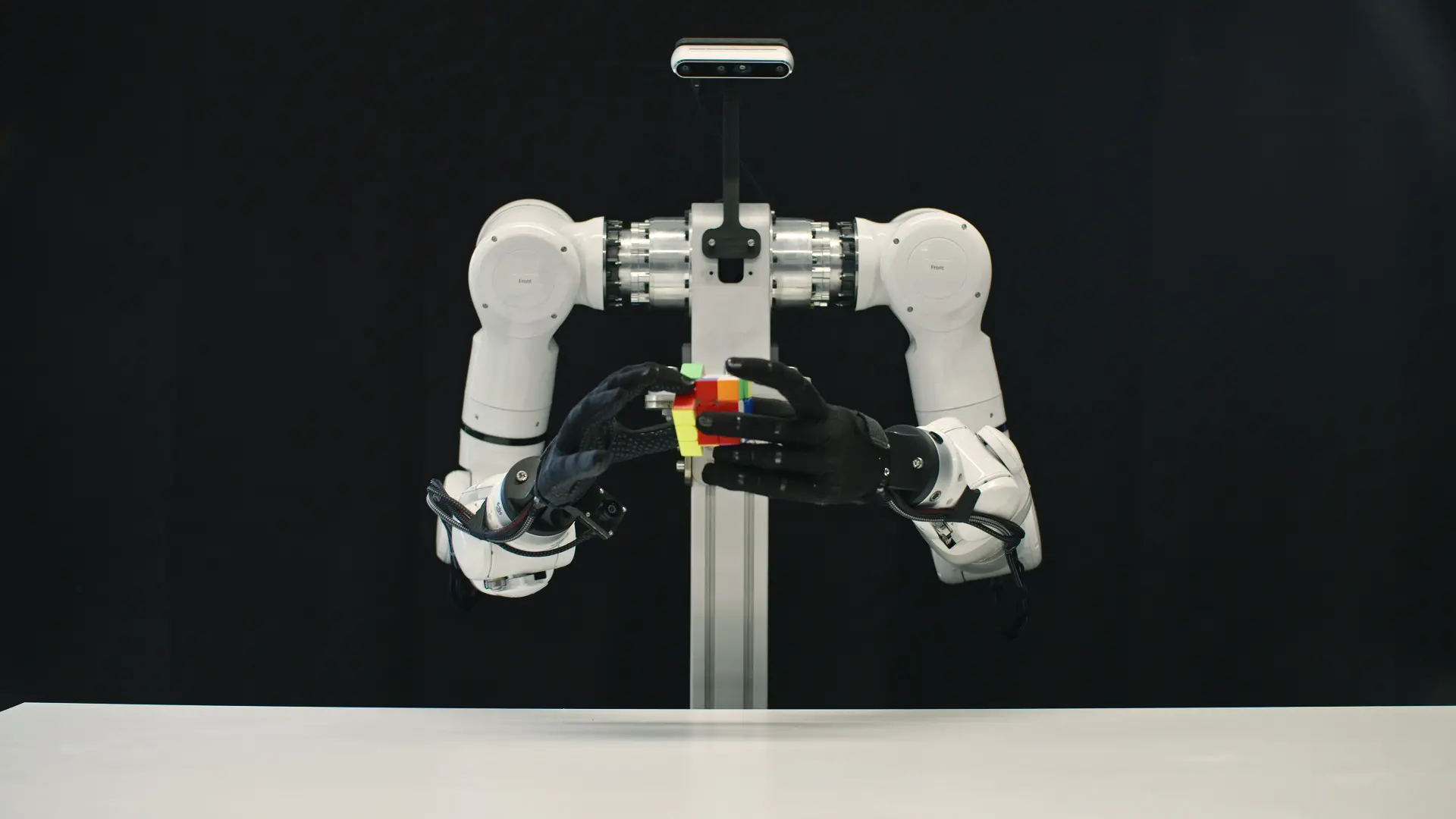
French robotics startup Genesis AI has unveiled GENE-26.5, its first foundational model, alongside a human-like robotic hand designed and built in-house. The company says the hand is capable of performing complex and delicate tasks such as cooking, playing the piano, or solving a Rubik's Cube. It is an early sign of how a new generation of AI-focused robotics companies is moving beyond single-purpose machines toward general-purpose physical AI systems.
Key facts at a glance
- Genesis AI has released GENE-26.5, its first foundation model for real-world robotics.
- The company also built a human-like robotic hand capable of complex tasks, including cooking, playing piano, and solving a Rubik's Cube.
- It completed a $105 million seed funding round in July of last year, co-led by Eclipse and Khosla Ventures.
- CEO Zhou Xian says the hand was built in-house to give the company more accurate control over the full technology stack.
- Genesis AI has created lightweight sensor gloves to capture worker data for training the model.
- The team of 60 is split roughly evenly between the US and Europe, with offices in San Carlos, Paris, and London.
- The company is working on a full-body, general-purpose robot.
From Model to Hardware
Genesis AI began with an ambition to create an AI model that could power real-world robots, but found that off-the-shelf hardware was not enough. According to co-founder and chief executive Zhou Xian, the company decided to build its own hand to gain more accurate control over the full stack, from data and algorithms to final mechanical design. The result is GENE-26.5, a foundation model tailored to robotics, and a five-finger robotic hand that closely mirrors human anatomy.
Most robotic hands available today tend to have two or three fingers. These simple grippers are effective in narrow industrial applications such as picking up boxes or sorting parts, but they are not well suited to tasks that require precision, sensitivity, and a wide range of motions. Genesis AI's human-like hand is intended to cover that gap. Because the hand resembles a human appendage, data collected from human actions can be transferred more directly to the machine, reducing the need for expensive, task-specific engineering.
Record Seed Funding
The company completed a $105 million seed funding round in July of last year, about £77.2 million at the time. The round was co-led by Eclipse and Khosla Ventures, and included Bpifrance, HSG, former Google CEO Eric Schmidt, telecom entrepreneur Xavier Niel, MIT Computer Science and Artificial Intelligence Laboratory director Daniela Rus, and Apple distinguished scientist Vladlen Koltun. The list of backers reflects growing investor interest in the convergence of artificial intelligence and physical robotics.
The funding has allowed Genesis AI to build a 60-person team split roughly evenly between the United States and Europe. Its headquarters are in San Carlos, California, with additional offices in Paris and London. The company says Europe remains important because of its deep talent base and the potential market of industrial customers.
A Hand Built for Skill Transfer
The mechanical hand is one of the most visible parts of Genesis AI's work. Unlike simpler grippers, it has a full set of fingers and a thumb, allowing it to hold, twist, and manipulate objects the way a person would. The design choice has practical implications for training. When a human demonstrates a task, the robot can map that demonstration to its own hand without requiring a complex translation layer. This makes video-based learning and data collected from sensor gloves far more useful.
Genesis AI has also developed lightweight sensor gloves that can be worn by workers over their hands. In fields such as pharmaceuticals and manufacturing, workers can perform their normal tasks while wearing the gloves, and the system captures the movements and pressures involved. That data can then be passed to the AI model to teach it fine-grained manipulation. Genesis says data from the gloves can also be combined with information gleaned from videos of workers carrying out tasks, giving the model a richer understanding of how real work is done.
Concerns for Workers
The sensor glove approach raises an obvious question: would workers be happy to help train a robotic replacement? There is no simple answer. In industries that already face labor shortages, some companies may present such data collection as a way to preserve tribal knowledge and improve workplace safety. But the long-term effect could include automation of tasks that are currently performed by people. The issue is likely to become more pressing as more robotics companies adopt similar data-collection strategies.
Demonstrating Potential
In a demonstration video released by the company, a pair of Genesis AI hands performed several complex or delicate processes. The hands are shown preparing a smoothie, playing the piano, and handling one of the most recognizable tests of manual dexterity: a Rubik's Cube. The demonstrations are short, but they are intended to show that the hardware and model can work together to produce smooth, coordinated movement rather than jerky, pre-programmed actions.
Each of these tasks requires different abilities. Preparing a smoothie involves reaching for ingredients, holding a cup, and using a blender. Playing the piano requires fine finger independence and timing. Solving a Rubik's Cube requires rapid rotation and precise orientation of the cube. By showing the same hardware across such varied tasks, Genesis AI is emphasizing the versatility of its foundation model.
Background and European Roots
Genesis AI's co-founder and president, Theophile Gervet, previously worked at France's Mistral, one of Europe's most prominent AI startups. That experience helped shape the company's approach to foundation models and its emphasis on European AI talent. The company has said its presence in Europe is not accidental; the continent has a growing pool of AI researchers, engineers, and industrial companies interested in automation.
The Genesis AI hand is not alone in a busy field. Companies around the world are working on humanoid robots, dexterous hands, and robot learning systems. Many use imitation learning, in which a robot learns by observing humans or by using teleoperation. A key challenge in this field is gathering enough high-quality data and making sure that data can be reused across different environments and tasks. Genesis AI hopes its combination of a foundation model, human-like hardware, and data-collection gloves can reduce the cost of that process.
Toward a Full-Body Robot
The company says it is already working to supplement the mechanical hand with a full-body, general-purpose robot. Such a robot would combine the dexterous hand with arms, legs, sensors, and an onboard computing system capable of running models like GENE-26.5 in real time. A full-body robot would be useful in warehouses, laboratories, and eventually home environments, but it also brings additional engineering challenges around balance, power consumption, and safety.
Zhou Xian and his team expect that progress will be incremental. Each new generation of hardware will provide better data, and each new version of the model will make better use of that data. The key insight behind Genesis AI's strategy is that intelligence and embodiment cannot be developed separately. A model trained only on digital data may know the steps involved in cooking, but it will not understand the weight of a pan, the flexibility of an ingredient, or the way a hand must adjust when slipping. By building a hand that feels like a human hand, the company is trying to put its AI model in a body where everyday human activity is within reach.
The field of embodied AI is still young. Many technical hurdles remain, particularly in areas such as long-term autonomy, energy efficiency, and generalization to unseen tasks. Yet Genesis AI's first release suggests that the gap between digital intelligence and physical action is beginning to close. The company is now working to expand beyond the hand and build a full-body general-purpose robot capable of handling a wider range of real-world work.
Source:Silicon UK News