

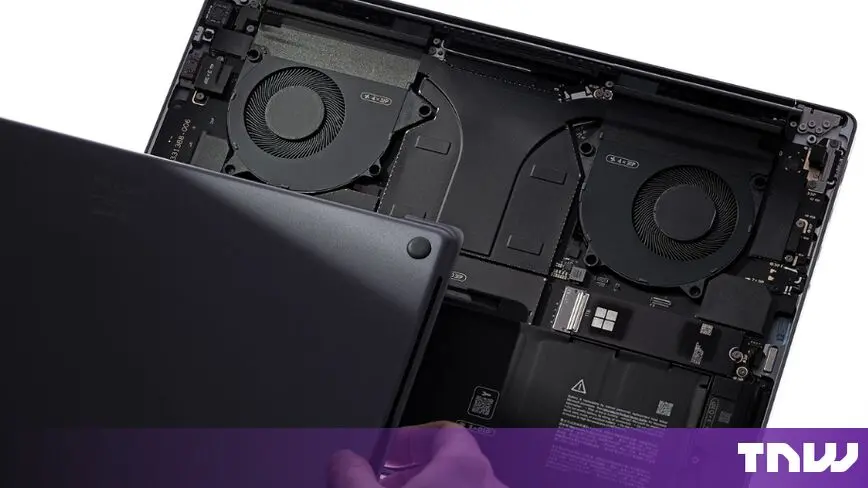
Microsoft has put a $2,599.99 price tag on its first Nvidia-powered Surface laptop and opened pre-orders, setting up a direct challenge to Apple's MacBook Pro. The Surface Laptop Ultra, as the machine is called, uses Nvidia's RTX Spark platform and runs on an Arm-based processor. Microsoft executives said on stage in San Francisco that the laptop returns prompts from locally run AI models twice as fast as a MacBook Pro M5 and generates video six times quicker. The company has not published the test methodology behind either claim.
The only performance figure Microsoft footnotes is the display. The Surface Laptop Ultra has a peak brightness of 2,000 nits, measured over a 10% window with HDR content, against laptops available in October 2026. Apple's numbers get no equivalent disclosure. The omission leaves the central comparison—Nvidia silicon versus Apple's M5—resting on stage claims rather than reproducible benchmarks.
Key facts
- Microsoft priced the Surface Laptop Ultra at $2,599.99 and opened pre-orders.
- The laptop is Microsoft's first Surface with Nvidia silicon.
- Microsoft claims it doubles a MacBook Pro M5 on local AI prompts and generates video six times faster.
- No test methodology has been published for either claim.
- The processor is built on Arm's architecture, licensed from the Cambridge company Nvidia failed to buy in 2022.
- Configuration options include up to 20 Nvidia Grace cores, up to 128GB unified memory and up to 2TB storage.
- The 2,000-nit screen is measured over a 10% window with HDR content against laptops available in October 2026.
- At $2,599.99, the Surface undercuts a 16-inch MacBook Pro by roughly $400.
What is inside the Surface Laptop Ultra
Microsoft's product page lists a processor of up to 20 Nvidia Grace cores, up to 128GB of unified memory and up to 2TB of storage. The chip at the center is RTX Spark, which pairs a Blackwell graphics processor with Nvidia's Grace CPU. Nvidia co-designed Grace with MediaTek, and the company claims up to one petaflop of AI compute. That figure places the laptop in a new category for Nvidia: a consumer machine that can run large AI models locally rather than relying on cloud servers.
Dell, HP, Lenovo, Asus and MSI are also shipping machines built on RTX Spark. The platform puts Nvidia into a laptop market that Intel and AMD have shared for decades. But Nvidia gets there on someone else's instruction set. Grace is built on Arm's architecture, licensed from the Cambridge company Nvidia agreed to buy for $40 billion. Regulators objected, and SoftBank confirmed the deal dead in February 2022. Every RTX Spark laptop now pays Arm a royalty instead. The arrangement underscores how Arm's design philosophy has spread from phones into PCs, servers and now AI-focused laptops.
Price, memory shortage and the MacBook comparison
The $2,599.99 starting price is aggressive for a first-generation Nvidia laptop. Analysts had thought cost was the open question because a memory shortage had pushed hardware prices up. Nvidia raised its DGX Spark by about 75%, to $6,950. Against that backdrop, the Surface undercuts a 16-inch MacBook Pro by roughly $400. The comparison matters because Apple has spent years positioning the MacBook Pro as the default machine for creative professionals and developers who want local AI performance. Microsoft is now trying to peel away that audience with a Windows laptop that runs Arm-based Nvidia silicon.
The memory shortage is not a minor detail. It has raised system prices across the industry and forced companies to stretch their refresh cycles. European laptop shipments are forecast to fall 6.4% this quarter and 20% in the fourth, with desktops down almost 30%. Gartner does not expect AI PCs to be a majority of shipments until 2028. That forecast suggests Microsoft and Nvidia are launching into a cautious market, not a boom. Buyers may be intrigued by local AI performance, but they are also facing higher prices and longer replacement cycles.
Why local AI matters to Microsoft
Microsoft's pitch has an unusual audience. Executives argued that running AI on the machine in front of you is cheaper and more secure than paying a cloud provider. That argument is gaining traction in Europe, where data sovereignty and cloud costs have become board-level concerns. The Dutch tax office reached that conclusion about its email this week and is moving it off Microsoft's cloud onto its own servers. The move is a reminder that the same logic Microsoft uses to sell local AI can also be turned against its cloud business. If organizations can run AI locally, they may also want to run email and other workloads locally.
For Microsoft, the Surface Laptop Ultra is about more than selling hardware. It is a showcase for Windows on Arm, Nvidia's AI PC ambitions and the idea that AI should run at the edge. The company has spent years trying to make Windows on Arm a viable alternative to x86 laptops. Early efforts suffered from app compatibility problems and underwhelming performance. Apple's M-series chips raised the bar by proving that Arm-based laptops could be fast, efficient and desirable. Nvidia's Grace CPU gives Microsoft another chance to close that gap, this time with a tightly integrated GPU that is optimized for AI workloads.
The chip race and the Arm royalty
The RTX Spark platform is notable because it combines Nvidia's GPU expertise with a general-purpose CPU. Nvidia has long dominated discrete graphics and AI accelerators, but it has not been a major supplier of laptop processors. Intel and AMD have controlled that market, and Qualcomm has recently pushed into Windows laptops with Arm-based Snapdragon chips. RTX Spark adds another competitor, but it also creates a new dependency: Arm. Nvidia's failed acquisition of Arm means the company must license the instruction set like everyone else. Every RTX Spark laptop pays Arm a royalty, and that royalty is a cost that ultimately shows up in the price of the machine.
Arm's rise in PCs is one of the quiet shifts in the industry. The company's architecture was once synonymous with smartphones and low-power devices. Apple's M1 chip changed that perception by showing that Arm could power high-performance laptops. Qualcomm followed with Snapdragon X chips for Windows. Now Nvidia's Grace CPU brings Arm into AI-focused laptops. Intel and AMD still dominate overall PC shipments, but the premium end of the market is increasingly contested by Arm-based designs. Microsoft's Surface Laptop Ultra is a bet that Nvidia's brand and AI performance can make Arm a selling point rather than a compromise.
What buyers get and what is missing
Beyond the chip, Microsoft is emphasizing repairability. The Surface Laptop Ultra has published repair guides, replacement parts and upgradeable storage. That is a departure from the sealed, glued-together designs that once defined premium laptops. It also responds to growing right-to-repair pressure in Europe and the United States. Upgradeable storage matters because AI models and video files consume large amounts of space. Buyers who want to run local models may need more than the base configuration, and the ability to add storage later could extend the machine's useful life.
What is missing is independent verification. Microsoft's performance claims are bold: twice as fast as a MacBook Pro M5 on local AI prompts, six times quicker at video generation. But without published methodology, it is impossible to know what prompts were used, what models were tested, what power settings were applied or how thermal throttling affected results. A laptop can post impressive peak numbers in a short demo and still struggle under sustained workloads. The lack of detail is not unusual for launch events, but it leaves the central competitive claim unproven.
The same is true of the display comparison. Microsoft says the Surface