

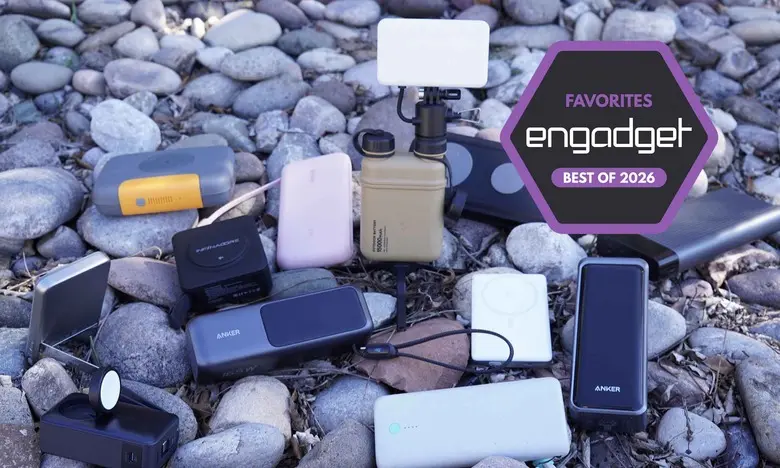
Finding yourself far from a wall socket when your phone hits five percent is nerve-wracking. If you stash a portable battery in your bag, you can avoid that feeling altogether. But with thousands of power banks on the market, it can be tough to pick the right one for your needs. We've spent years testing dozens of batteries and found the best power banks for different scenarios. Whether you need a quick reup for your phone or a huge brick to keep your laptop alive, there's something here for you.
Key facts
- The Anker MagGo Power Bank (10K) is the best MagSafe charger thanks to Qi2-certification and a built-in kickstand.
- The Anker Nano Battery (Foldable USB-C) is the best Android companion for its ultra-portable design and 22.5W output.
- The Anker 10K Fusion combines a wall plug and USB-C cable for a low-capacity best pick.
- The Belkin BoostCharge 20K with Integrated Cable offers great value in the medium-capacity category.
- The Nimble Champ Pro delivers fast 65W charging with a sustainable build.
- The BioLite Charge 100 Max is the top choice for multi-device charging, including laptops.
- The Anker Laptop Power Bank with built-in cable is the best laptop power bank.
- The Anker Prime Power Bank 26K 300W is the premium pick with an app and optional charging base.
- The Nestout 15000mAh Outdoor Battery is waterproof and rugged for outdoor use.
Best power banks for 2026
Best MagSafe power bank
Anker MagGo Power Bank (10K)
Capacity: 10,000mAh | Maximum Output: 15W (wireless) | Ports: One USB-C in/out | Included cable: USB-C to USB-C | Number of charges iPhone 15: 1.64 | Charge time iPhone: 4 to 100% in 2h 26m and 0 to 70% in 1h 8m | Weight: 8.82 oz | Dimensions: 4.22 x 2.71 x 0.78 in
Anker's MagGo Power Bank was one of the first Qi2-certified products on the market, and the new standard has made the popular MagSafe/kickstand model much faster. It's the most well-rounded MagSafe battery we've tested. In testing, it brought an iPhone 15 from near-dead to half-full in about 45 minutes. For reference, it took the former top pick in this category an hour and a half to do the same. After that initial refill, the MagGo 10K had enough left to get the phone up to 70 percent on a subsequent charge.
Besides faster charging speeds, this wireless power bank adds an LCD display showing the battery percentage left in the bank, plus the approximate time before it's full (when refilling) or empty (when charging). A strong MagSafe connection makes it easy to use the phone while it charges, and the small kickstand creates a surprisingly sturdy base for watching videos. If you twist the phone to landscape, StandBy mode kicks in.
The power bank also charged our Galaxy S23 Ultra well, though that model doesn't have Qi2 support. New Pixel 10 phones do, so those handsets will charge at a faster rate with this battery and benefit from zero-effort magnetic alignment. The MagGo also has a USB-C port for devices without wireless capabilities.
Pros:
- Qi2 tech enables extra fast wireless charging
- Sturdy kickstand props up iPhones as it charges
- LED display for battery percentage
Cons:
- More expensive than other MagSafe packs
Best portable charger for Android
Anker Nano Battery (Foldable USB-C)
Capacity: 5,000 mAh | Maximum Output: 22.5W | Ports: One USB-C and one USB-C connector | Cable: USB-C to USB-C | Number of charges Galaxy S23 Ultra: 0.65 | Charge time: 0 to 65% in 1h 2m | Weight: 3.5 oz | Dimensions: 3.03 x 1.45 x 0.98 in
The Anker Nano power bank has impressive power delivery for its size. It's the exact size and shape of a lipstick case and has a built-in USB-C connector that folds down when not in use. That means, in addition to being ultra-portable, you don't need to remember to grab a charging cable when you toss it in your bag. There's also a built-in USB-C port that can refill the battery or be used to fill up a different device with an adapter cable. Four indicator lights let you know how much charge remains.
In our testing, the 5,000mAh battery provided enough charge to get a depleted Galaxy S23 Ultra back up to 65 percent in about an hour. That's relatively quick, but the Nano is also small enough that, with its sturdy connection, you can use your phone while it's charging without feeling too awkward. The charger's small size also makes it a good pick for recharging earbuds.
For a little more juice and an equally clever design, Anker's 30W Nano Power Bank is a good option for delivering a single charge. It's bigger in size and capacity (10,000mAh) and includes a display indicating the remaining charge percentage. The built-in USB-C cable doubles as a carry handle, which is a nice touch. That cable is in/out, and there's another USB-C in-out port in addition to an out-only USB-A port.
Pros:
- Very portable
- Affordable
Cons:
- Small enough to get misplaced
Best low-capacity power bank
Anker 10K Fusion
Capacity: 10,000mAh | Maximum Output: 30W | Ports: One USB-C in/out port, one USB-C in/out cable, wall prongs | Cable: Built-in USB-C | Number of charges iPhone 15: 1.86 | Charge time iPhone: 5 to 100% 1h 53m and 5 to 91% 1h 5m | Number of charges Galaxy S23 Ultra: 1.45 | Charge time Galaxy: 5 to 100% 1h 2m, 5% to 50% 23m | Weight: 8.8 oz | Dimensions: 4.25 x 2.0 x 1.22 in
The toughest thing about using a power bank is remembering to bring it along. You also have to remember a cable and, if you want to refill the bank itself, a wall adapter. Anker's 10K Fusion solves two of those problems with its attached USB-C cable for your gadget and foldable two-prong plug for charging the bank itself. Yes, you still have to remember to bring the thing with you.
Despite the attachments, it's compact, just a smidge wider than a stick of butter, yet still packs a 10,000 mAh capacity. The 30 watts of power enabled the 'Super Fast Charging' message on a Galaxy S23 Android phone and got it from five percent to full in just over an hour. In just 20 minutes, the 10K Fusion bumped a near-dead iPhone 15 to 45 percent. Though it slowed down towards the end of the Apple handset's charge.
There's an additional USB-C port for charging devices that may require a different cable, and both it and the built-in connector can be used to refill the power bank. The cable makes a neat loop that looks a lot like a handle. Even though we're wary of carrying a device around by its cord, it felt sturdy enough.
The onboard display indicates the Fusion's remaining charge as a percentage and was one of the more accurate readouts we've tested. We also like the corduroy texture along the sides — very fidget-worthy.
Our previous pick in this low-capacity category, the BioLite Charge 40 PD, is still an excellent choice — it's durable, delivers a quick charge and looks cool. We use it often ourselves. Plus BioLite has an admirable mission of bringing energy to places where it's otherwise scarce. But Anker's new release, the 10K Fusion simply delivers a faster charge and more features at a lower price.
Pros:
- Has a built-in USB-C cable
- Also has built-in wall prongs
- Display is fairly accurate
- Affordable
Cons:
- iPhone charging is slower than other banks in its range
Best medium capacity power bank
Belkin BoostCharge 20K with Integrated Cable
Capacity: 20,000mAh | Maximum output: 30W | Ports: One built-in USB-C in/out cable, one USB-A port, one USB-C port | Cable: USB-C | Number of charges iPhone 15: 3 – 3.5 | Charge time iPhone: 5 to 100% in 2h 6m | Number of charges Galaxy S23 Ultra: 2.5 – 3 | Charge time S23 Ultra: 1h 15m | Weight: 14 oz | Dimensions: 6.06 x 3.0 x 0.99 in
An integrated cable seems to be the hot new feature in portable chargers — and we're all for it. We can remember times when we've had a dead phone and power bank, but no way to connect the two. The Belkin Boost Charge 20K with Integrated Cable is one such bank we've tested and also one of the more affordable examples.
It can output a maximum of 30 watts, which doesn't make it the fastest charger around, but it wasn't a slouch. It charged a Samsung Galaxy S24 Ultra from near-dead to full in an hour and 15 minutes and bumped an iPhone 15 from five to 87 percent in just over an hour. And the 20,000mAh capacity means it can achieve those numbers around three times over.
In addition to the built-in (and conveniently magnetized) USB-C cable, there are two other ports: an out-only USB-A and an in/out Type C. That means you can technically charge three devices at the same time, but just note that the amount of charge and the time it takes for things to refill will both take a hit.
There's no digital screen to tell you how much charge remains in the battery, just four indicator LEDs. We've certainly found display readouts to be helpful in determining just how much more juice you can squeeze out of a battery, but the lighted pips here are accurate and still useful.
While color options probably won't make or break your battery pack purchase, we appreciate that the BoostCharge 20K comes in something other than standard black. You can of course get it in that shade, but also in blue, pink or white. The pink of our tester unit was pale and pretty and the matte finish does a good job of staying clean — some black smudges from who-knows-what in our bag came off easily with some rubbing alcohol.
Pros:
- Built-in USB-C cable is handy
- Comes in four color options
- Affordable
- Great capacity for the price
Cons:
- Charge isn't as fast as other banks
Best medium-high capacity power bank
Nimble Champ Pro
Capacity: 20,000mAh | Maximum Output: 65W | Ports: Two USB-C in/out | Cable: USB-C to USB-C | Number of charges iPhone 11: 2.95 | Charge time iPhone: 5 to 100% in 1h 39m average | Number of charges Galaxy S22 Ultra: 2.99 | Charge time Galaxy: 5 to 100% in 59m average | Number of charges iPad Air: 1.83 | Charge time iPad: 5 to 100% in 1h 55m and 83% in 1h 21m | Weight: 12.9 oz | Dimensions: 5.92 x 2.48 x 1.00 in
Nimble's Champ Pro battery delivers a screaming fast charge and got a Galaxy S23 Ultra from five percent to full in under an hour. That's faster than every other battery we tested except for Anker's Laptop Power Bank, our premium pick — and that model costs $30 more. It lent nearly three full charges to both an iPhone and Galaxy device and has enough juice to refill an iPad more than once. The battery pack itself also re-ups from the wall noticeably faster than other models, so it'll get you out the door quicker.
The company, Nimble, is a certified B-Corp, meaning they aim for higher environmental and social standards and verify their efforts through independent testing. The Champ Pro uses 90 percent post-consumer plastic and comes in packaging made from paper scrap with a bag for shipping back your old battery (or other tech) for recycling.
The unit itself feels sturdy and has a compact shape that's a little narrower than a smartphone and about as long. The attached adjustable lanyard is cute, if a little superfluous, and the marbled effect from the recycled plastics give it a nice aesthetic. You can charge devices from both USB-C ports simultaneously, and both are input/output plugs.
Our only qualm was with the four indicator lights. On a second testing round, it dropped down to just one remaining pip, yet went on to deliver a full fill-up plus an additional top off after that. That said, we're glad the indicator lights under-estimated the remaining charge rather than the other way around, and the accuracy seemed to improve after subsequent depletions and refills.
Pros:
- Super fast charging
- Made from recycled materials
- Sturdy and compact design
Cons:
- Indicator lights underestimate charge
Best multi-device power bank
BioLite Charge 100 Max
Capacity: 25,000mAh | Maximum total output: 120W | Ports: Wireless pad (15W), two USB-C (100W), one USB-A (15W), one USB-C (15W) | Cable: USB-C to USB-C (100W) | Number of charges iPhone 15: 5 | Charge time iPhone: 5 to 100% in 1h 52m (wired) 2h 38m (wireless) | Number of charges Galaxy S23 Ultra: 4 | Charge time S23 Ultra: 1h 4m | Number of charges iPad Air: 2.2 | Charge time iPad: 5 to 100% in 2h 20m | Number of charges MacBook Pro: 0.75 | Charge time MacBook Pro: 57 m | Weight: 1.28 lbs | Dimensions: 5.5 x 4.4 x 1.38 in
The compact and rounded design of the Biolite Charge 100 Max makes it more packable and conducive to travel than many larger units. It was also a touch faster in refilling most devices, but since the Charge 100W is $50 more expensive for slightly less capacity, it earns runner-up status.
In addition to four USB ports (three Type-C and one Type-A), it has a MagSafe-compatible wireless charging pad on one side, with a maximum output of 15 watts. The magnetic hold is enough to keep it in place as it charges, but it's not as strong as you'll find on smaller MagSafe batteries — we wouldn't carry it around during a refill.
The 10 LED pips indicate the remaining charge and we found those to be pretty accurate, though the last pip doesn't flash before it dies like other batteries. The rubberized texture and yellow accents are a welcome aesthetic change from the techy black look of most larger batteries — and it's quite nice to hold. There's also plenty to appreciate about the company itself: a climate neutral-certified B-Corporation that helps bring lights and cook stoves to energy impoverished areas around the world.
Pros:
- Compact and colorful design
- Delivers a quick charge to phones, tablets and laptops
- Company is a climate neutral-certified
Cons:
- More expensive than similar-capacity batteries
Best laptop power bank
Anker Laptop power bank with built-in cable
Capacity: 25,000mAh | Maximum output: 165W | Ports: Two built-in USB-C in/out cables, one USB-A port, one USB-C port | Cable: USB-C to USB-C | Number of charges iPhone 15: 4 – 5 | Charge time iPhone: 5 to 100% in 1h 54m | Number of charges Galaxy S23 Ultra: 3.75 – 4 | Charge time S23 Ultra: 52m | Number of charges iPad Air: 1.75 – 2 | Charge time iPad: 5 to 100% in 1h 58m | Number of charges MacBook Pro: 0.68 | Charge time MacBook Pro: 53 m | Weight: 1.31 lbs | Dimensions: 6.18 x 2.12 x 1.93 in
The only thing worse than needing a power bank and not having one is having one but no way to connect it to your device. The Anker laptop power bank with built-in cable forgoes any clever naming scheme, but makes sure you're never left without a way to charge your stuff.
It has two attached USB-C cables: one attached to the side of the battery that acts as a carrying cable and another retractable cord that extends up to two feet. Both handle in/out functions so you can use them to refill a device or reup the battery itself.
The display tells you the amount of charge remaining in the battery pack as well as the output wattage that's funneling towards your devices from each port. When refilling the battery, you can see an estimate of how long it will be until the unit is full. Calculating and displaying info like that takes up a bit of power but, in our testing, the unit outputs the same or a higher amount of charge compared with other 25,000 mAh batteries.
It's an attractive, high-capacity bank, with matte silver exterior and a smaller display area than Anker's Prime bank (our previous pick for this category). One of our concerns with that battery was the huge display area which was easily scratched. This newer unit feels more durable.
It's worth it at just $15 more than Anker's popular Powercore bank, as that bank doesn't have built-in cables.
Pros:
- Two built-in USB-C cables so you're never without a cord
- Durable build
- Display shows detailed charging information
- Delivers a fast charge
Cons:
- Screen picks up smudges easily
Best premium power bank
Anker Prime Power Bank 26k 300W
Capacity: 26,250mAh | Maximum combined output: 300W | Ports: Two USB-C (140W), one USB-A (22.5W) | Cable: USB-C to USB-C (240W) | Number of charges iPhone 15: 5 – 5.5 | Charge time iPhone: 5 to 100% in 1h 41m | Number of charges Galaxy S23 Ultra: 4.3 | Charge time S23 Ultra: 1h 9m | Number of charges iPad Air: 2.5 | Charge time iPad: 5 to 100% in 1h 50m | Number of charges MacBook Pro: 0.83 | Charge time MacBook Pro: 1h 12m | Weight: 1.32 lbs | Dimensions: 6.3 x 1.5 x 2.5 in
We knew it wouldn't be long before we came across an app-connected power bank — the portable battery landscape is crowded and brands are no doubt looking for ways to stand out. Anker's latest Prime Power Bank (26K, 300W) does stand out, but it's not because of the app. Yes, it works, letting you see the remaining charge, how much power is going to a device and other bits of data on your phone. But we can't imagine this info being important to most people. If it is, the same numbers are available on its built-in display anyway.
What's actually impressive are the speeds the bank delivers, the large capacity and the extra simple recharging via the optional base. The three ports can be used all at once, with the two USB-C ports delivering up to 140 watts each. It's tough to think of a scenario where that actually happens, as most devices recharge far below that wattage, but if you ever need to partially charge two high powered laptops at the same time, you can.
More commonly, the battery will simply give phones, tablets and laptops speedy refills. It got a near-dead iPhone 15 to 60 percent in a half hour and delivered more charge to our MacBook Pro than any other battery we've tested. The display not only tells you how much charge is left in the battery, it also has a temperature gauge — a wise thing to keep an eye on when it comes to lithium ion batteries.
The attractive and sleek design has a shiny black front where the display lives and a matte silver body. The bank is more compact than most 27,000mAh batteries out there. Anker made the battery a little wider and flatter than the last round of Prime devices, which makes it a bit easier to handle and somehow looks more elegant than the square brick did.
The charging power base is a separate (and optional) purchase, but it makes recharging the battery extra convenient — you just plunk it down and walk away. It's the same base used with the previous line of Anker Prime batteries, so if you have one already, you're set. Unfortunately the base costs $110. Combined with the battery, that's more than $300, but if you want a truly premium power bank, this is it.
Pros:
- Delivers a super fast charge
- Sleek and premium design
- Display shows remaining charge and battery temperature
Cons:
- Pricey, especially with the optional base
Best power bank for outdoors
Nestout 15000mAh Outdoor Battery Power Bank
Capacity: 15,000mAh | Maximum Output: 32W | Ports: One USB-C in/out, one USB-C in, one USB-A | Cable: USB-A to USB-C | Number of charges iPhone 11: 2.99 | Charge time iPhone 11: 0 to 100% 2h average and 0 to 99% in 1h 45m | Number of charges iPad Air: 1.17 | Charge time iPad: 0 to 100% 2h 23m and 0 to 17% 15m | Weight: 12.8 oz | Dimensions: 5.0 x 1.25 x 3.0 in
Plenty of battery packs are built to withstand drops and other abuse, but very few are waterproof or even water resistant. It makes sense; water and electrical charges aren't good companions. The Nestout Portable Charger battery has an IP67 rating, which means it can handle being submerged in water for a number of minutes, and Nestout claims a 30-minute dunk in a meter of water shouldn't interfere with the battery's operation. We couldn't think of a likely scenario where a power bank would spend a half hour in three feet of water, but we could see a backpacker traversing a river and submerging their pack for a few minutes, or a sudden downpour drenching all of their gear. So we tested by dropping the battery in a five gallon bucket of water for five minutes. After drying it off, the unit performed as if it had never been wet.
The water resistance comes courtesy of screw-on caps with silicone gaskets that physically keep the water out, so you'll need to make sure you tighten (but don't over tighten) the caps whenever you think wetness is in your future. The company also claims the battery lives up to a military-standard shock/drop specification, which sounds impressive, but it's hard to pin down what exactly that means. We figured it should at minimum survive repeated drops from chest height onto a hard surface, and it did.
As for charging speeds, it wasn't quite as quick as our recommendation for a mid-capacity bank. The Belkin charged an iPhone 15 to 80 percent in under an hour and the Nestout got the smaller iPhone 11 to 80 percent in a little more than that. Another thing to note is that the supplied cable is short, just seven inches total, so you'll likely want to use your own cord.
Nestout also makes accessories for its batteries, which we found delightful. A dimmable LED worklight snaps on to the top of the battery while a small tripod holds them both up. The portable solar panel reminded us of a baby version of Biolite's camping panels. Nestout's version refilled the 15,000mAh bank to 40 percent in under three hours, which sounds slow, but is actually fairly impressive considering the compact size of the panels. This is also a blazingly hot summer, so we'd expect better performance in more reasonable weather.
Pros:
- Waterproof with the caps secured
- Clever accessories (sold separately)
- Survived drop tests
Cons:
- Not the fastest charge times
- Included cable is short
What to look for in a portable battery pack
Battery type
Nearly every rechargeable power bank you can buy (and most portable devices) contain a lithium-ion battery. These beat other current battery types in terms of size-to-charge capacity, and have even increased in energy density by eight fold in the past 14 years. They also don't suffer from a memory effect (where a battery's lifespan deteriorates due to partial charges).
Flying with portable batteries
You may have heard about lithium ion batteries overheating and catching fire — a recent Hong Kong flight was grounded after just such a thing happened in an overhead bin. Current restrictions
Source:Engadget News