

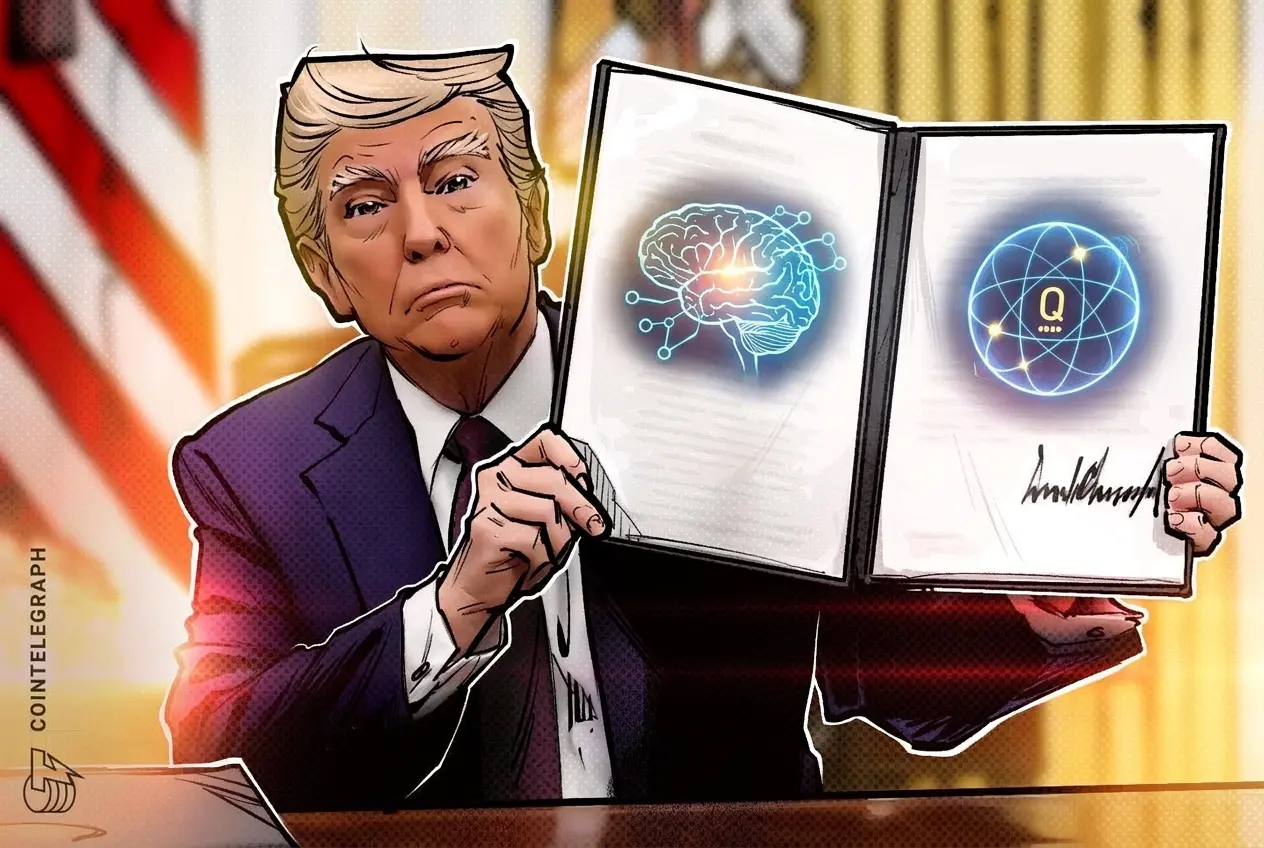
The White House has announced a package of more than $6 billion in science initiatives that combines a new quantum computing competition with a broad set of artificial intelligence commitments from technology companies. The announcement places two advanced technology fields at the center of federal research policy at a moment when investors, regulators and security experts are trying to gauge how quickly quantum machines could move from laboratory experiments to practical systems.
The Department of Energy said on Thursday that it had identified eight scientific applications to guide its Quantum Genesis Q Competition, which offers up to $215 million in planned funding to companies developing fault-tolerant quantum computers. The program was first announced in September and uses milestone-based awards and incentive prizes for companies that can demonstrate increasingly powerful quantum systems. Its research priorities span chemistry, materials science, subatomic physics and applied mathematics.
Separately, the White House said 11 technology companies had pledged $2.4 billion in AI tools and compute credits to support research at 15 federal agencies. The commitments include $1 billion from Nvidia, $500 million from AMD, $200 million from OpenAI and $150 million each from Anthropic and Google.
Key facts
- The White House announced more than $6 billion in science initiatives.
- The Department of Energy outlined a $215 million Quantum Genesis Q Competition for fault-tolerant quantum computers.
- The competition is guided by eight scientific applications and uses milestone-based awards and incentive prizes.
- Research priorities include chemistry, materials science, subatomic physics and applied mathematics.
- Eleven technology companies pledged $2.4 billion in AI tools and compute credits for 15 federal agencies.
- Company commitments include $1 billion from Nvidia, $500 million from AMD, $200 million from OpenAI, and $150 million each from Anthropic and Google.
- The quantum push comes as financial regulators and crypto firms assess potential risks to public-key cryptography.
A two-track federal science push
The package is notable for pairing a targeted quantum computing program with a separate, industry-backed AI effort. The quantum competition is structured as a public challenge, with the government setting research priorities and companies competing for funding tied to technical milestones. The AI commitments, by contrast, are pledges of tools and computing resources from private companies for use across federal agencies. Together, the two tracks reflect a policy approach that mixes direct government sponsorship with private-sector capacity.
The announced total is larger than the two headline components, with the quantum competition and AI pledges accounting for the most detailed portions of the package. The White House has framed the effort as a science push, but the specific programs show how advanced computing has become a national policy priority. Quantum computing and AI both depend on scarce technical talent, specialized hardware and long research timelines, and both have implications for economic competitiveness and national security.
Inside the Quantum Genesis Q Competition
The Quantum Genesis Q Competition is designed to support companies working toward fault-tolerant quantum computers. In current quantum systems, qubits are highly sensitive to noise, temperature changes and other environmental disturbances. Fault tolerance refers to the ability of a quantum computer to correct errors continuously and perform reliable calculations over long periods. Achieving fault tolerance is widely viewed as a critical step toward useful, large-scale quantum computing.
The Department of Energy said the competition would use milestone-based awards and incentive prizes. That structure is meant to tie funding to demonstrated progress rather than early-stage promises. Companies that show increasingly powerful quantum systems can qualify for additional support as they advance. The eight scientific applications identified by the department are intended to focus the competition on practical research areas rather than general-purpose hardware development alone.
The research priorities span chemistry, materials science, subatomic physics and applied mathematics. Those fields are relevant to quantum computing because they include problems that may be difficult for classical computers but potentially tractable for quantum machines. Chemistry and materials science, for example, involve complex molecular and material interactions that could benefit from quantum simulation. Subatomic physics and applied mathematics provide foundational problems for testing quantum algorithms and error-correction techniques.
The $215 million in planned funding is modest compared with the overall scale of global quantum research spending, but prize-style programs can have an outsized effect by directing attention to specific technical bottlenecks. The competition also gives the government a way to evaluate companies against common milestones. For smaller quantum firms, milestone awards can provide non-dilutive capital and a credible signal to investors. For larger companies, the competition may serve as a benchmark for progress in error correction and system scale.
Why fault-tolerant quantum computing matters
Quantum computers use qubits, which can exist in superpositions of states and can be entangled with one another. These properties allow quantum machines to explore certain computational paths in ways that classical computers cannot. In theory, quantum computers could solve some problems in chemistry, optimization and cryptography far faster than classical systems. In practice, today’s machines remain noisy and limited in scale.
Fault tolerance is the threshold at which a quantum computer can correct its own errors reliably enough to run long algorithms. Building a fault-tolerant machine requires many physical qubits to create a smaller number of logical qubits, and the overhead can be substantial. Researchers must improve qubit quality, gate fidelity, error-correction codes and system architecture at the same time. Progress is often measured through benchmarks rather than immediate commercial applications.
The policy interest in fault tolerance is not only scientific. Governments and companies view quantum computing as a strategic technology because it could affect cryptography, defense, drug discovery, materials design and financial modeling. The Department of Energy’s competition is therefore part of a broader effort to build domestic expertise in quantum hardware and software. The milestone structure may also help agencies compare different technical approaches, from superconducting circuits to trapped ions and other qubit modalities.
Quantum risks for crypto and financial cryptography
Advances in fault-tolerant quantum computing could have implications for blockchain-based assets that rely on public-key cryptography. Public-key cryptography allows users to prove ownership of digital assets and authorize transactions without revealing their private keys. Widely used systems such as RSA and elliptic-curve cryptography depend on mathematical problems that are believed to be hard for classical computers to solve.
A sufficiently powerful quantum computer running Shor’s algorithm could, in theory, derive a private key from an exposed public key. For crypto assets, that could allow an attacker to steal funds from addresses whose public keys are known. The risk is not evenly distributed across all addresses. Some blockchain addresses expose public keys only when funds are spent or under certain conditions, while others may be more exposed. The precise risk depends on the blockchain protocol, wallet design and how keys are managed.
No quantum computer capable of carrying out such attacks currently exists. The engineering challenges remain enormous, and the timeline for fault-tolerant quantum computing is uncertain. Even so, security experts have begun to plan for a future in which quantum machines could threaten existing cryptographic standards. The concern is not only current attacks but also data that could be collected now and decrypted later, a risk often described as harvest-now-decrypt-later.
On Sept. 23, three EU financial watchdogs warned that the development of more powerful quantum computers could undermine cryptographic systems used to secure blockchains and financial transactions. The warning added a regulatory dimension to a debate that had largely been led by cryptographers and technology companies. For financial institutions, the challenge includes inventorying cryptographic dependencies, assessing exposure across legacy systems and planning migrations to quantum-resistant algorithms.
Blockchain networks face particular complications because they are decentralized and often rely on community governance. Upgrading cryptographic standards in a public blockchain requires coordination among developers, miners or validators, wallet providers and exchanges. Some networks may be able to adopt post-quantum signatures through protocol upgrades, while others may face longer transitions. The risk is further complicated by the fact that digital assets can be held in self-custody, where users are responsible for migrating keys and wallets.
AI commitments from 11 companies
The AI portion of the announcement centers on private-sector commitments rather than new government appropriations. Eleven technology companies pledged $2.4 billion in AI tools and compute credits to support research at 15 federal agencies. The commitments include $1 billion from Nvidia, $500 million from AMD, $200 million from OpenAI and $150 million each from Anthropic and Google.
Because the pledges are described as tools and compute credits, their value may be delivered through access to hardware, software, cloud resources and model services rather than direct cash transfers. That structure can be useful for agencies that need specialized computing capacity but may not have the procurement channels or budgets to buy it quickly. It also allows companies to support public research while exposing their platforms to federal users.
The AI commitments could support work across a wide range of agencies, from scientific research to data analysis and operational tools. Federal agencies have been exploring AI for tasks such as drug discovery, climate modeling, fraud detection and administrative efficiency. The availability of compute credits could lower barriers for researchers who lack access to large-scale GPU clusters or advanced AI models. At the same time, the arrangements raise questions about procurement rules, data governance, security requirements and long-term dependence on private platforms.
Policy and industry context
The announcement comes amid a broader global competition in quantum computing and AI. Governments in Europe, Asia and North America have launched national quantum
Source:Cointelegraph News